
HQ Review: Leverage Dance Theater presents “The Spaces Between Us”
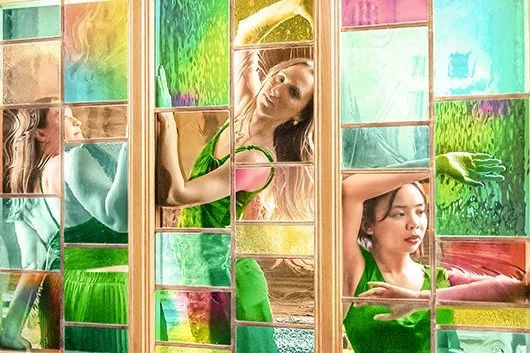
The Jefferson Avenue Mission is quiet; street noise and chimes bleed in occasionally as the patrons of Leverage Dance Theater’s The Spaces Between Us eagerly wait for it to begin. The Spaces Between Us is the fifth iteration of Leverage’s Sacred Spaces series where the company creates site-specific work in spaces “designated for the purpose of encouraging, inviting or generating ‘spiritual’ connection or experience". Chosen for its former career as a house of worship, Jefferson Avenue Mission is the essential venue for this event’s part laboratory-part repertoire showing. Light streams through the walls of stained glass casting a yellow glow on the pews separated by an aisle, carpet, and audience at the head of the sanctuary.
Preluding the event, company director Diana Lia Barrios introduces the audience to the Sacred Space series, the work being done by the company, as well as how the company members prepare for the event. As Barrios speaks, the six company members enter the sanctuary: they run their fingers along the pews’ spines, review choreography, and stand, swing, and stretch on and through the pews in order to reconnect with the space. While this warm up was not a formal component of the show, it felt deeply important to witness, as it allowed for the audience to sink into the space alongside the dancers.
The laboratory was the first section of the event and required the audience to engage in the choreographic process. In preparation for The Spaces Between Us, the company created a few phrases of movement off of which the audience would guide and direct the dancers in order to create a collaborative piece. To begin the laboratory, Barrios directs the audience to consider the space we are in and how we connect with the spiritual and sacred. We consider this prompt and the space we are in to generate concepts to guide the intention of the piece: Rectangle of Matter; Light; Reverence; Surrender. Additionally, the audience views the movement phrases created for this event.
As the laboratory continues, Barrios polls the audience on staging choices, movement quality, and timing until we edit and redraft the work to completion. This process was a beautiful showcase of the effort, preparation, and reliance on what ‘feels right’ that is essential to dance making. I found this laboratory to be a delightful immersion and reminder of what it is to be an artist and human that seeks to collaborate with others.
Upon the completion of the laboratory, the audience stepped outside for the showing of the company’s repertoire. Beginning with Paige Van Nest’s work Dropped, the dancers bounce and jog down the Mission’s steps over to where we sit on picnic benches and find their places. As the music’s bass bounces on Jefferson Street and the wind blows, the dancers sink and sway finding rhythm and groove– they bring a house party to this outside place. As the work’s momentum grew, the movements began to smoothen and expand with reaches before dropping back into the work’s integral bounce. In the work’s conclusion, each dancer seems to be called back into the Mission–individually they bounce and jog inside.
We follow and return to our seats to view the laboratory piece we created with costuming and lighting. As the dancers enter the sacred space the audience is reintroduced to the directives we gave and the dancers’ responding choices. The audience instructed the company to infuse their own relationship to the sacred into the work: how would they approach this sanctuary? Some approached curiously, some with joy, and others with a tentative, cautious touch. Another focus of the laboratory was story telling: what is the process of embracing the sacred and eventually surrendering while on a spiritual journey? We watch as the dancers’ move through the pews and then slowly lift their hand to the sky in unison– a moment of togetherness and acknowledgement of the journey they are on together, but separately. This unison prompts the phrasework the company previously created: turning, sweeping, and expanding arms and legs that end in a presentation of themselves to the audience before falling back into their individualized patterns and movements. One by one they leave the sanctuary– continuing their journey onward.
Next was Agua choreographed by Diana Lia Barrios and the company’s past and present performers. Set to wave sounds, this work’s structure could only be described as molecular. Unison, cannon, and the Mission’s pews were utilized to layer movement and mimic lapping waves. As an audience member this work felt visceral in the sense that it created an easy and gentle hypnosis for the audience to fall into: you witnessed and floated with the dancers as they moved without hurry on, over, and through the pews. Concluding the showing was Nicole Halama’s Let Go, an intense and yet tender exploration of conflict and tension within relationships . Three dancers in navy costumes stand in the sanctuary as three dancers in white approach their duo partner. Moving throughout the sanctuary, the duos partner and spar: pushing, pulling, and cradling each other through conflict, tenderness, and finally to resolution. One dancer from each duo leaves their partner, looking back before walking through the swinging sanctuary doors.
As the event ended and I walked through the Mission, past stained glass, and into the daylight– I was caught in the delightfulness of an event like The Spaces Between Us. Showcasing the process of creation in relation to site specific work invites the audience to create their own world and recognize who they are and how they relate to the world around them and the broader community. I would recommend a Sacred Space event to any creative hoping to engage with the broader community and the sacred within themselves.