
HQ Review: Saint Louis Dance Theatre’s Winter Series features masterpieces by Inger and Kylián





Opening the second half of Saint Louis Dance Theatre’s (STLDT) Love Languages Season was their Winter Series, featuring two programs, each with vastly different styles, themes, and choreography to showcase the versatility of their incredible dancers. For this review, we will focus on the program performed on Saturday, February 28th, featuring: Jamar Roberts' Good Grief, Kirven Douthit-Boyd's Facing Shores, Johan Inger's Walking Mad, and Jiří Kylián's Sechs Tanze.
The opener, Good Grief, took a deep dive into the complexities of the titled emotion. It was a larger ensemble piece of 10 dancers with the standard structure of three movements: ensemble, solos, and a coda. It was set to jazz music by Oded Tzur, Petros Klampanis, Nitai Hershkovits, Johnathan Blake, Shai Maestro, and Ziv Ravitz. Choreographer Jamar Roberts used every element at his disposal to express this intricate state of being. These elements varied from the obvious, lighting and music, to the more nuanced, movement quality and dynamics between the dancers. Roberts’ choice of Noir jazz music was the perfect way to encapsulate the feeling of going through such difficult times. This style of music, with its slow tempos, minor keys, and solo instrumentation, can sound hollow and empty, much like the feeling of losing someone or something. To complement the music, Roberts used the expressive nature of the hands to convey emotional weight rather than relying on facial expressions. This is evident throughout the second half of the piece when Jamar presented four solos. Whether it be Angel wide palmed covering their face in despair, Jada keeping her arms to her side as if in denial, or Demetrius shaking his fists in anger. During these four solos, Robert used a spotlight underneath a disco ball to create an atmosphere of isolation, furthering the message. Many recognize a disco ball as a positive experience, an invitation for strangers to dance together and share in the fun. Which is why, when Roberts has an individual dancing alone under the disco ball’s glow, it helps invoke a sense of loneliness. The final element Roberts employed was the dynamics between the dancers. Grief not only affects the individual, but the community around them. Roberts knew this and wanted to display this through his ensemble work. One standout moment was when dancer Will Brighton, usually happy throughout the piece, dances around fellow dancer Angel Khaytyan to try to cheer him up. However, Angel, so deep in their own grief, resists Will’s advances and eventually shoves him away, leaving Will in a state of shock. Good Grief is great due to the sum of its parts. If any component were not there, the piece would risk losing its connection to the audience. But thanks to Roberts’ masterful attention to detail towards the music, lighting, and choreography, Good Grief sticks the landing. It leaves the audience deep in thought about the powerful and complex emotion that is grief.
Next was Kirven Douthit-Boyd's Facing Shores. It was a smaller piece with only 4 dancers (Miles Ashe, Sergio Camacho, SenSasheri Maasera, and Dave McCall) and lasted a little over 5 minutes. But it was packed full of drama. The music of Pavel Haas was reminiscent of the famous Dies Irae theme found in many classical pieces. The theme gave the work a powerful, haunting feeling. The dancers in white were blasted with spotlights, casting shadows that made the scene seem intimate yet vast. And the choreography, with its long sprawling moments of floor work and gestures of groveling to the audience, all elevated the drama to the point of biblical. Facing Shores was a powerfully charged piece. It was a demonstration of how the company can impact the audience in a short amount of time.
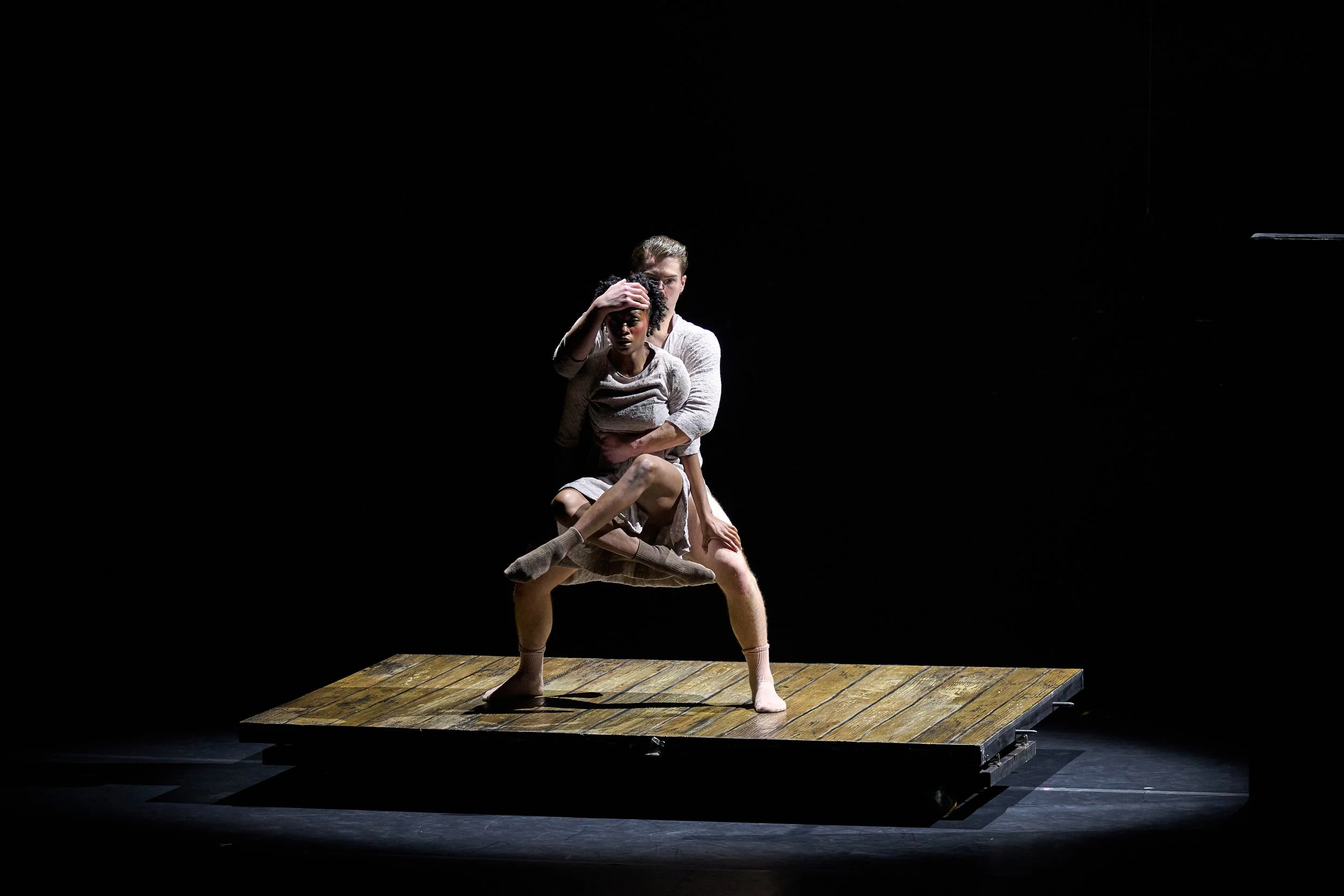
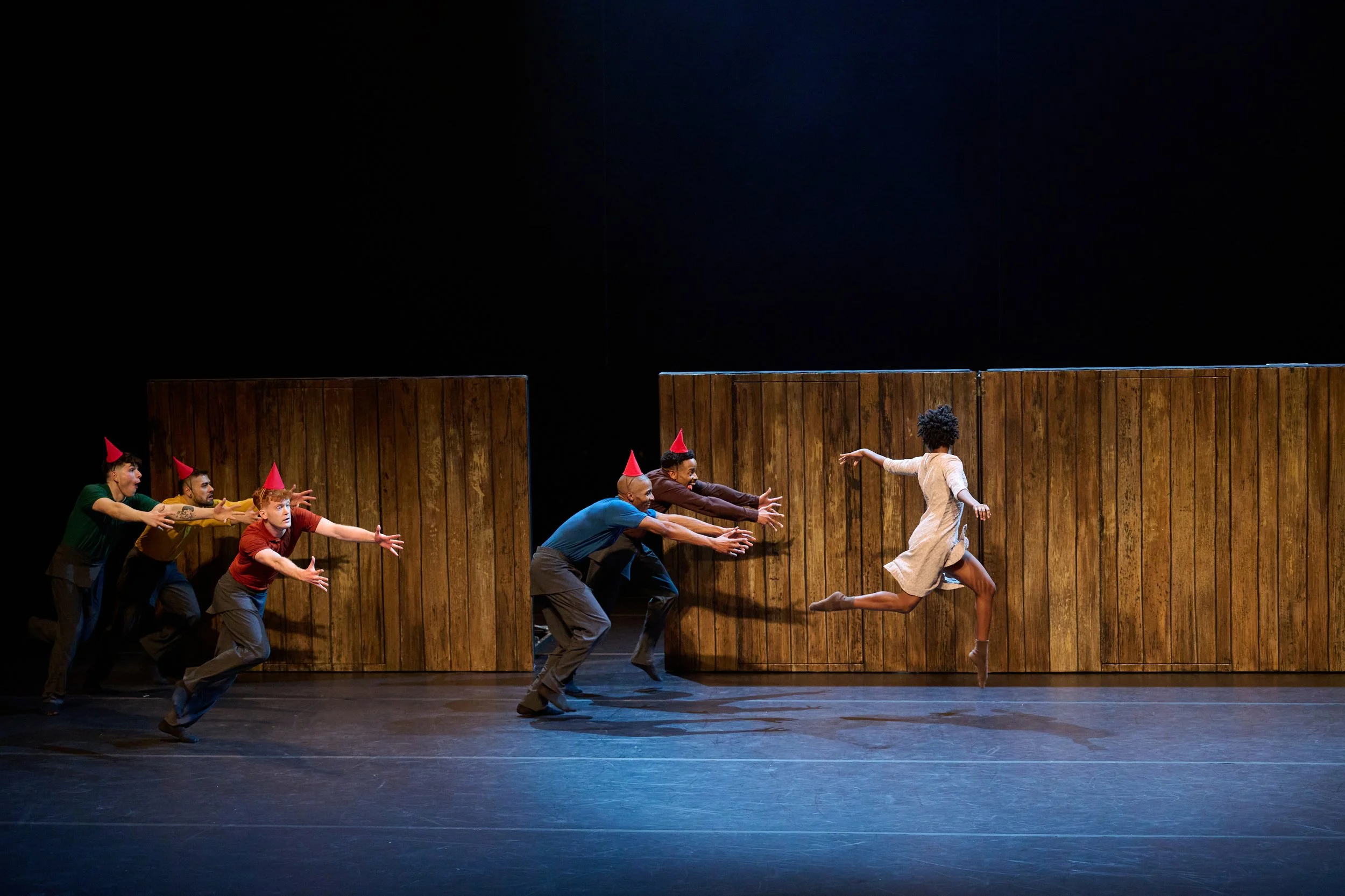
After a brief intermission, dancer Keenan Fletcher walked through the audience, unannounced, wearing a coat and hat. He looked around as if searching for his seat until he found himself wandering onto the stage. It is not until he lifted the curtain that the lights fully dimmed, and Johan Inger’s Walking Mad began. Keenan finds Molly Rapp walking around picking up abandoned jackets, much like his own. When he tries to hand her his, she refuses and walks off stage. Keenan, now confused, suddenly gets slammed by a wall that at first seemed to be a simple set piece. One of the four doors, once invisible to the naked eye, opens, revealing dancers Jada Vaughan and Spencer Everett. As Ravel’s famous Bolero begins to play, the two perform a quirky duet; Spencer's seriousness only heightens all the bombastic moments Jada executes as she tries to entice him to dance with her. After a few failed attempts, Spencer leaves Jada to her own devices. She dances a brief solo but gets quickly chased away by several dancers, all wearing red party hats. Once again, hilarity ensues as the men slowly get comfortable being goofballs, shaking their hips, and twerking against the wall. The scene hits its climax when the women join in. Dancer, Gillian Alexander, enters first and is denied a party hat, so she sulks, facing the center of the wall as if in a time-out. The other two women, Jada and Molly, received party hats and joined the rest of the dancers in their shenanigans as they quite literally began hooting and hollering. Things take a drastic turn once all the dancers wearing party hats exit behind the wall. The lights suddenly go out, the wall folds in on itself, and the music ends abruptly, leaving Gillian in absolute silence. The tone shifts, and Gillian begins her solo with only a spotlight illuminating her. She seems lost and confused until Angel Khaytyan enters through one of the wall doors. They are facing her, back to the audience, giving him a look of aggressive dominance. They go into a rather one-sided pas de deux, Gillian clearly not wanting to be a part of the dance. Angel gets aide halfway through the duet as other dancers enter and partner with a reluctant Gillian. This section, though sudden, was wonderfully executed by Gillian and Angel. With the music playing very faintly in the background, it created an atmosphere of intimidation and fear; the fun and jollity from the previous scene is far behind them. This scene continues until Gillian voluntarily dances with the ensemble, and Bolero returns in full swing. All the dancers re-enter wearing the same coats and hats Keenan wore at the beginning of the piece. They dance in hysterics, with Keenan looking like he is trying to escape the insanity. It was a terrific culmination when the dancers laid the wall flat and danced on top of it. Keenan finally collapses from exhaustion, the dancers run back behind the wall, and Bolero ends, but the piece is not over. When the lights were restored, they revealed Molly holding Keenan’s jacket with an expression of anger and sorrow. Arvo Prät’s, Für Alina for piano began to play, and Keenan and Molly started to dance an intense pas de deux. The pas ends with Keenan crawling up onto the wall. Then, with his back facing the audience, he takes a step forward and plummets off the wall, disappearing from eyesight, leaving Molly all alone.
Walking Mad, simply put, was a masterpiece. Inger used comedic tropes to help create the light atmosphere in the first section. This is wonderfully juxtaposed in the quiet middle section, during Gillian’s solo and duets. And both only added more heft to the finale with its extreme tones of madness from the coda and the utter anguish of the finale pas. This piece also contained some of the best performances of the season from many of the dancers. This is particularly true for Gillian, Molly, and Keenan. Gillian used her movement quality to express feelings that are indescribable in words, which is the very purpose of dance. Molly’s lines and stability were unmatched, and Keenan's strength in his grace and partnering was only outdone by his powerful expressions. Walking Mad only got better as it progressed and should be a returning piece in the company’s repertoire for many seasons to come.
The final piece of the night was Jiří Kylian’s Sechs Tanze, a satire ballet set to Mozart’s Sechs Deutsche Tanze, KV 571. Sechs Tanze literally translates to “six dances” in English. The dancers, all wearing sparse undergarments that look like they derive from the 18th century. The men wore powdered wigs, and the women styled their hair in messy buns. These six dances were nonsensical and fragmented with no rhyme or reason. The movements were lyrical and fluid as one would expect from a balletic piece. However, during the movements, the dancers' expressions were intentionally grotesque and over-the-top. They also had flashes of pure chaos that lacked any form of decorum. These moments are not something one would expect to come from 18th-century high society. They were yo-yoing each other, moving each other like rag dolls, or whispering in each other's ears and reacting as if they'd told a dirty secret. Each of the six dances was separated by scenes of men posing behind black dresses that were on wheels. They would push these dresses around while judging each other, attempting to stab at each other, or eating an apple off a sword. These rather outlandish moments only escalated the burlesque and illogical nature of the dances that came before it. Once again, all the dancers were at their A game, but the dancers behind the prop dresses, Spencer Everett and Miles Ashe, stole the show. Their hilarious depictions of the egotistical aristocrats, oddly enough, helped keep a through-line in the rather irrational piece. Overall, Sechs Tanze was a crazy but enjoyable piece to witness.
The Winter Series showcased amazing moments for Saint Louis Dance Theatre. From the complex expressions of grief in Jamar Roberts’ Good Grief, the incredible drama in Kirven Douthit-Boyd’s Facing Shores, the absolute perfection of Johan Inger’s Walking Mad, and the joy of Jiří Kylián’s Sechs Tänze, each piece helped create an evening that confirmed the company's incredible range and promising future.