
HQ Review: Space Station’s Winter Weekend with Miller, Halm, and Sapozhnikov
Launching Space Station’s 2026 season, Winter Weekends assembled six seasoned artists for a split-bill evening. Touring from Illinois with her collaborators, Anna Sapozhnikov presented “Good House Keep.” St. Louis-based artist Melissa Miller presented “DAPHNE” alongside her collaborator Laura Halm visiting from Baltimore, Maryland. Each work surfaced questions embedded in the subtle—yet pervasive—aspects of the feminine experience.
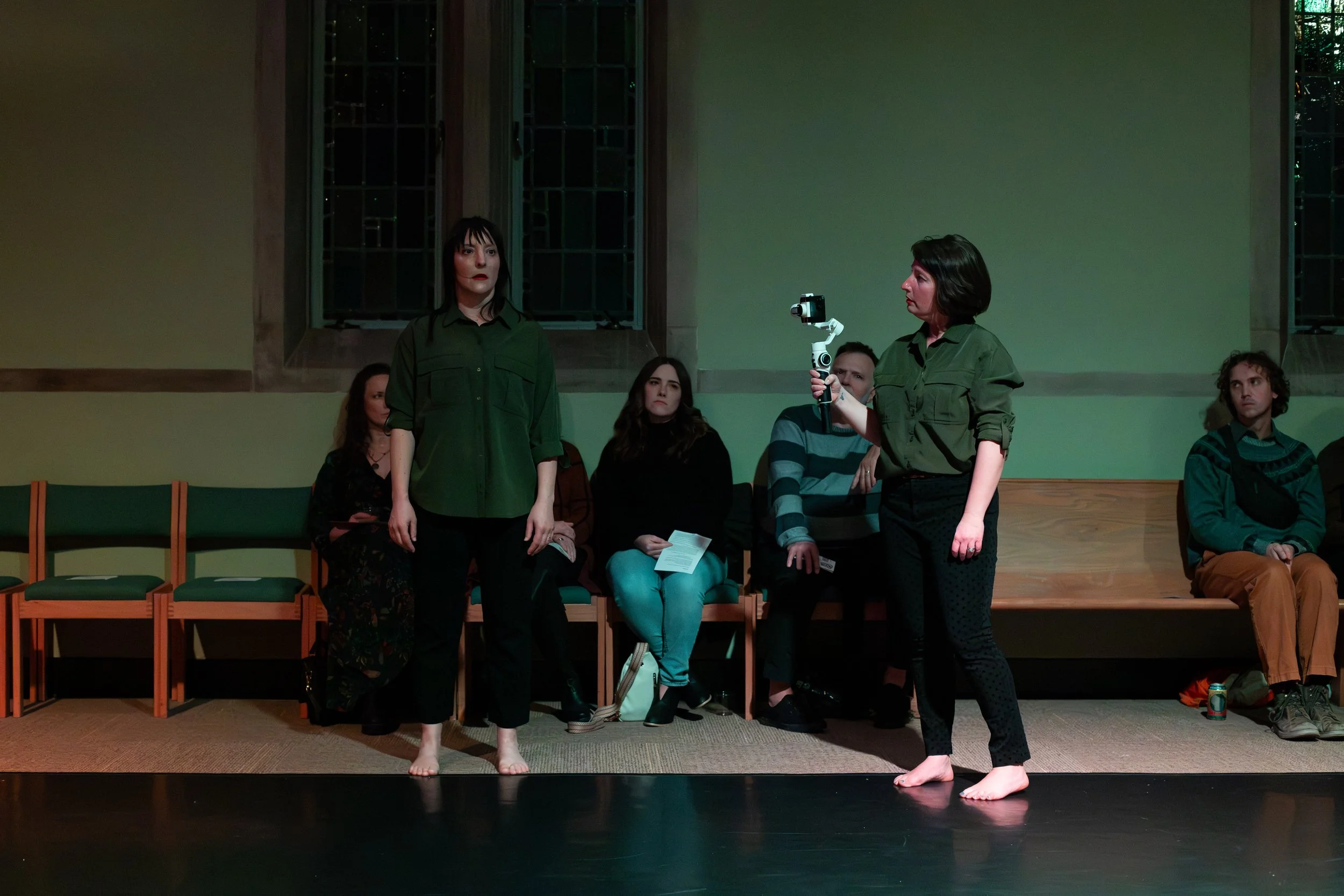
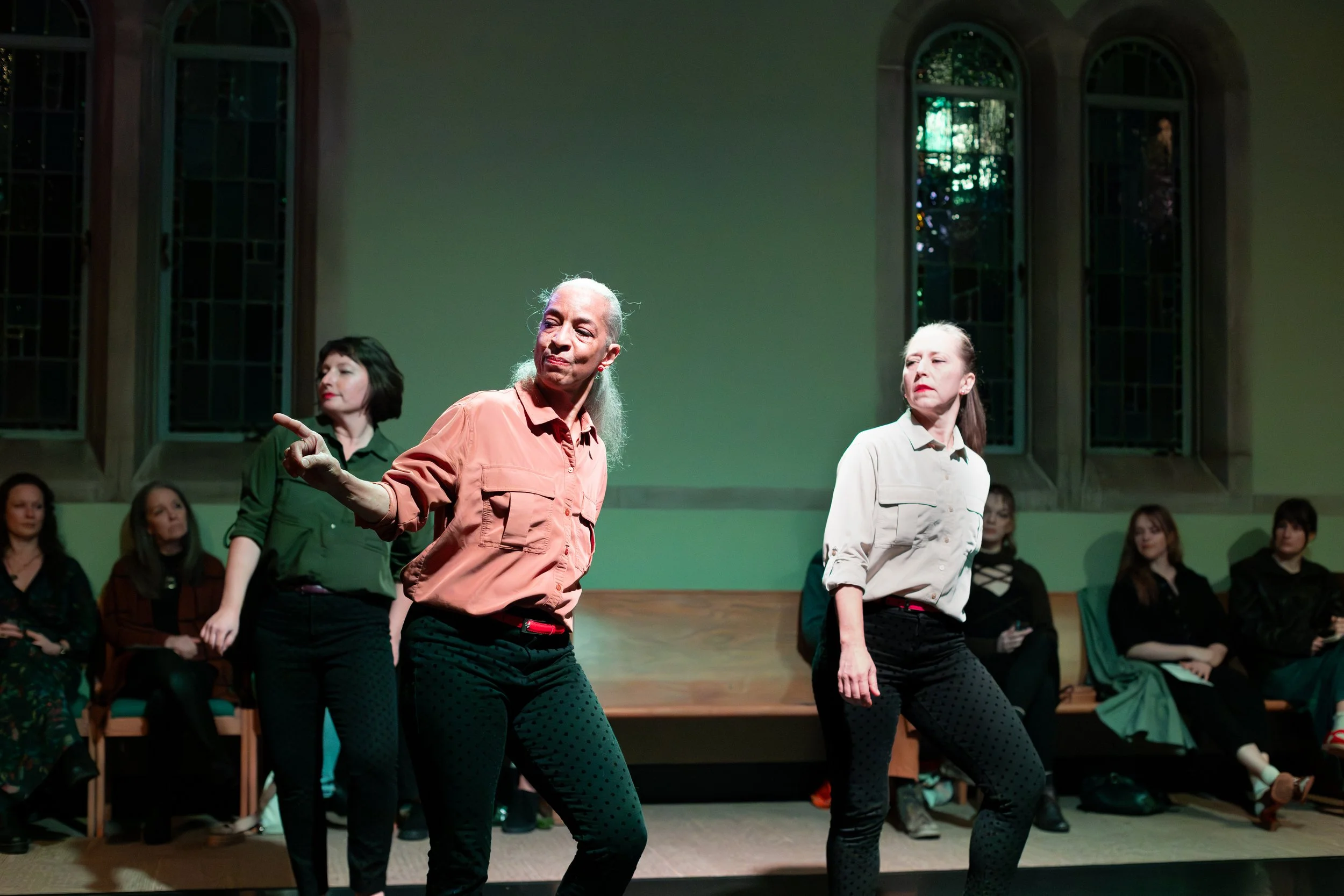
Opening the show with the house lights still up, “Good House Keep” quickly drew focus to observation and gaze. Documentarian and performer Laura Chiaramonte entered holding a gimbal while filming the audience as she circled the stage. The question of who is truly on display arose, building a palpable tension between the viewers and the work. Sapozhnikov and collaborators Nicole Marini and Roxane D’Orleans Juste took the stage shortly after and began moving to distorted audio of a vintage exercise tape. A methodical gesture phrase developed between the trio as Chiaramonte turned the camera to the performers. The exercise tape’s marching orders melted into background noise. Combined with the pressure-cooker intensity of the circling camera on record mode, the videographer’s presence embodies an ever-present external gaze.
The vocabulary of this work evokes the sensation of ‘fitting into something.’ Linear floor patterns suggest containment in a small space. As if hitting a wall, the muscles pulled taut in expressions of a routine sort of strain. The shapes then dissolved into open-palmed offerings before reorganizing. The traces of this work’s inspiration — a 1959 exercise record meant to cinch the waistline — seem to emerge through abstracted postures of old-school workouts. An underlying pursuit of perfection is present in the muscle-dense gestures of this piece, opposed by brief expressions of untamed femininity. A momentary swiveling of the hips lands powerfully in the larger context of this work, which in most cases stays physically and spatially contained. Under the constant gaze of the circling camera matched with the increasingly distorted audio, the awkwardness of these disruptions was intensified.
On opening night, the post-performance Q&A with the artists provided insight into Chiaramonte’s real-time documentation throughout the work. Chiaramonte’s role in early rehearsals was primarily dedicated to gathering video for archival purposes, Sapozhnikov explained, but as the piece developed, her presence felt integral. A discussion about observation and viewing feels central to this work.
“There are these rings of observation—there’s the performance, and then me watching them, and you (the audience) watching all of us,” Chiaramonte said. “I'd rather be a support instead of this intrusive presence, a supportive presence.”
Chiaramonte and her camera's presence felt like both a support and an intrusion, but an altogether necessary piece in communicating a fundamental idea: the female experience is one of constant surveillance, both self-imposed and outwardly enforced. While the sound score and inspiration for this piece drew from a late-1950s workout tape, this surveillance captures a broader milieu: thoughts wander to the feeling of confinement to traditional duties, an idea that in 1963 was coined “the problem that has no name” by feminist writer and activist Betty Friedan in her book The Feminine Mystique. An ache so subtle, and so frightening to admit, that even its name went unnamed. Like this work, the rebellion must be just as subtle, bubbling right beneath the surface.
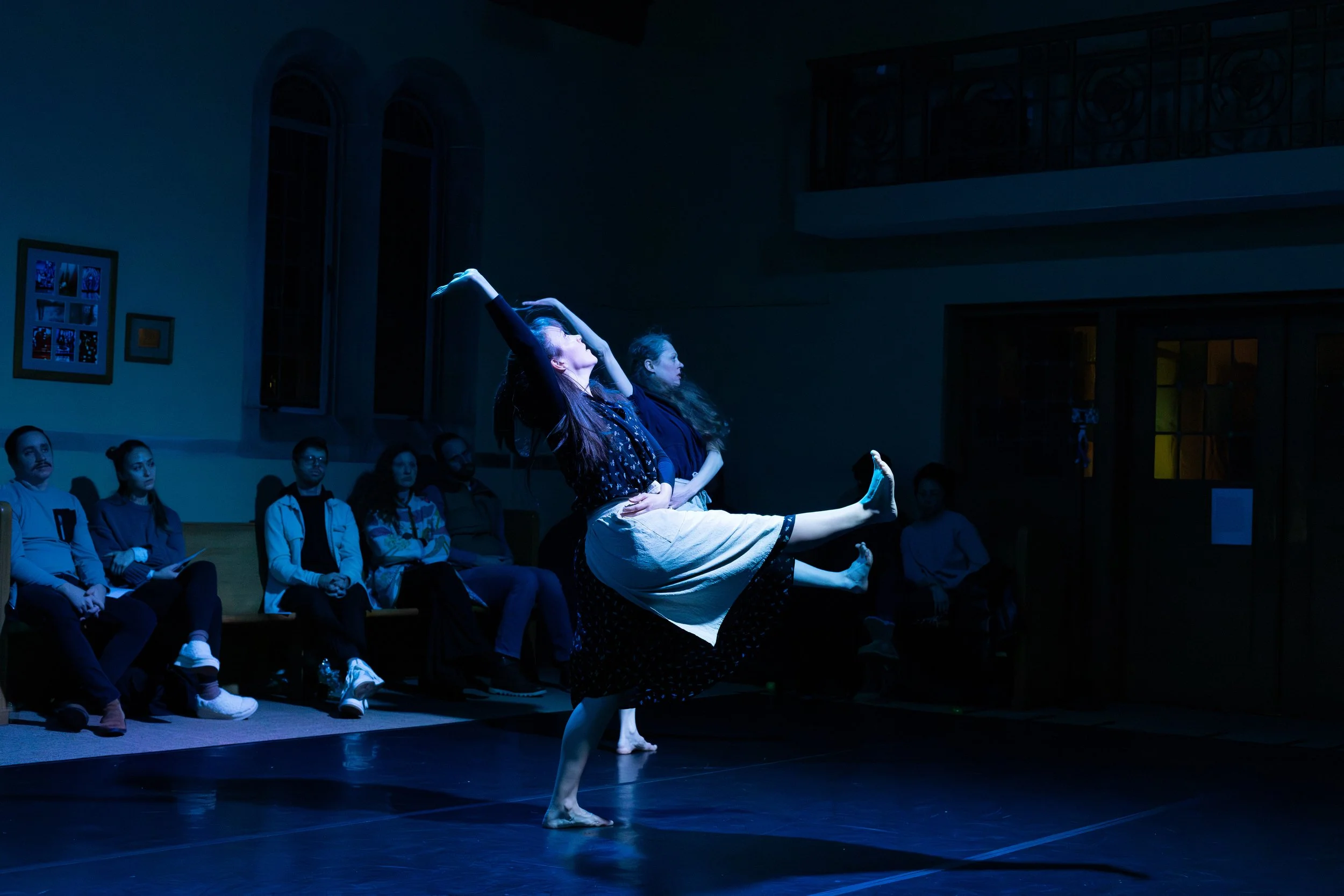
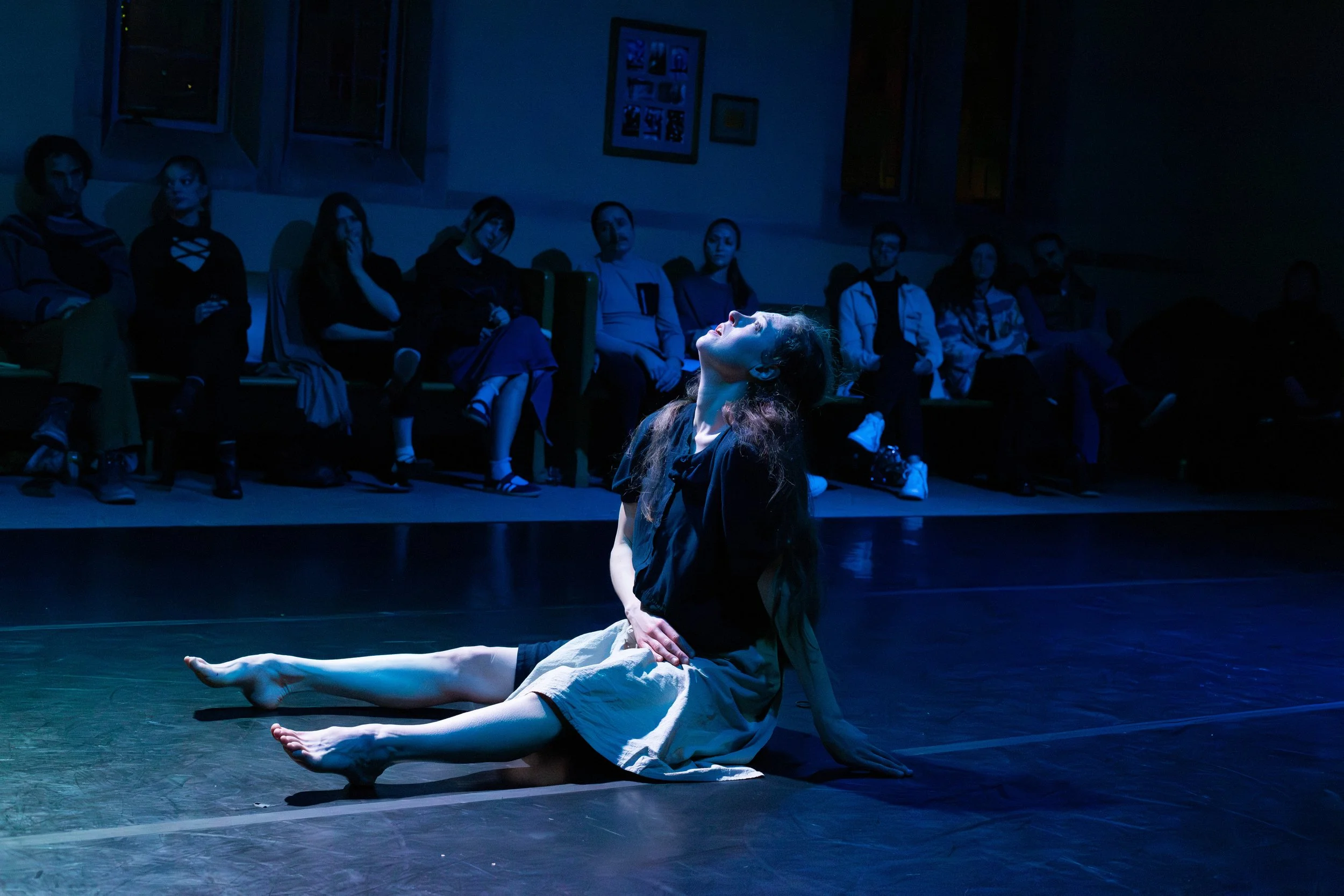
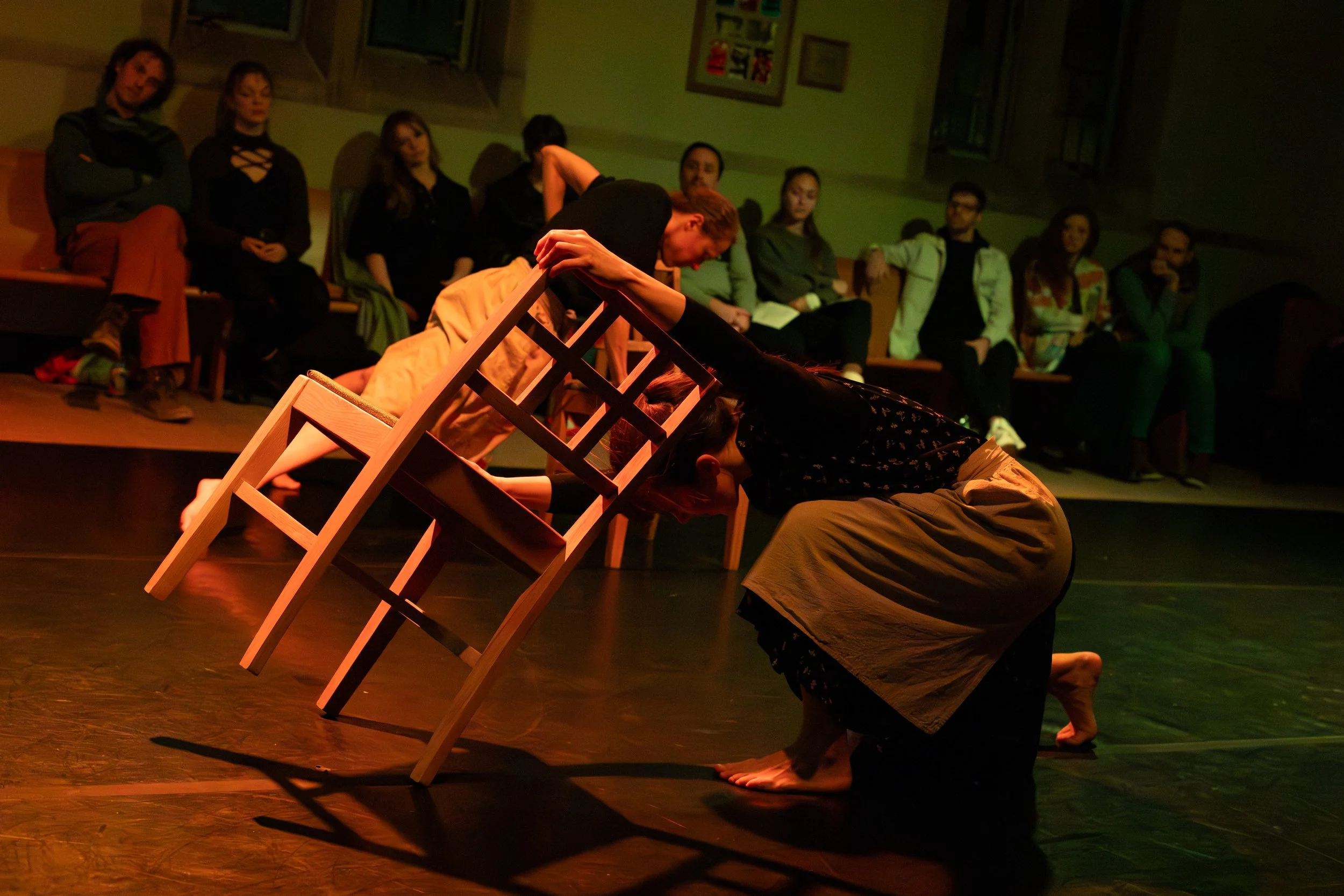
Continuing themes of rigidity, structure and rebellion against antiquated advice came “DAPHNE,” a debut for the work choreographed by Melissa Miller and Laura Halm. Described in the program note as a dance-theater work reinterpreting the Greek myth of Daphne, this piece used several devices — costuming, props, music and a dynamic text arrangement by Miller — that allowed for a distinct story to take hold.
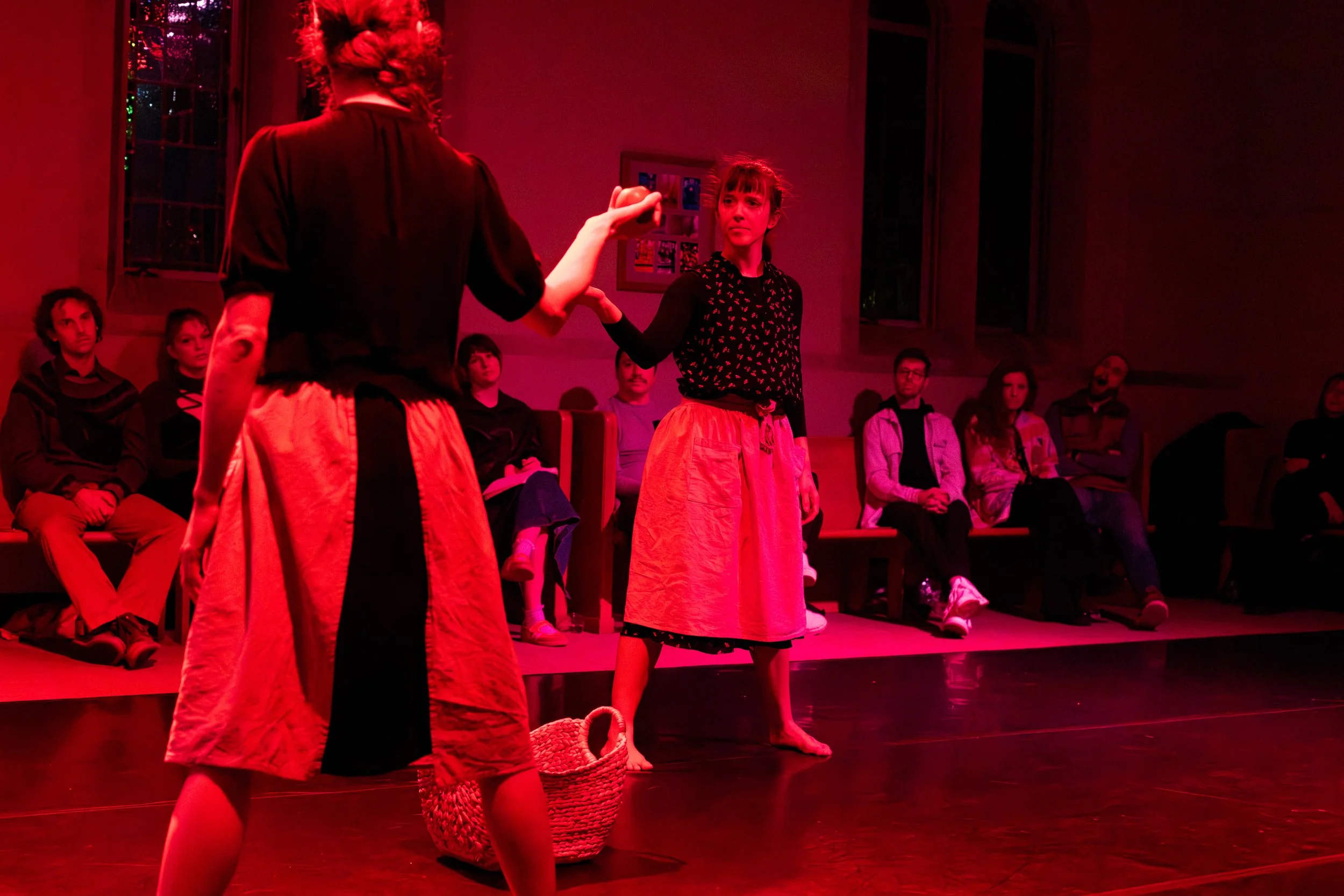
Clad in aprons and hoisting baskets of apples, the duo made a heavy-footed entrance to a set of chairs and began carving the fruit. Natural light and lilting birdsong captured an age-old vignette of working women. A complicated relationship between the two developed using a rearrangement of poetry by Claire Wahmanholm as a back and forth dialogue. “Once upon a time, the soil…” Melissa started, hopeful. “Once upon a time we are placed in a field,” Laura continued the story, but with a tone of admonishment. The terms mother and daughter are never verbalized, but the dynamic is proposed through the text and subtle differences in movement: Where Melissa’s movement is free, Laura’s is set. Melissa’s movement guileless, the solar plexus open, Laura’s is explicit, somewhat absolute. We are dropped into a relationship that is frustrated and on the edge of collapse, but approaching transformation. This frustration is released through more than one climactic moment. Viewers witnessed the shifting of roles, and in a healing moment, the optimism of the child appeared to overcome in the end. This release was not unearned — a thorough buildup of innovatively threaded text and repeating phrasework arrived at a satisfying change in dynamic.
Burning fire embers, whistling wind and birdsong were elemental to the soundscore, but the primary score involved shaker hymns, spiritual hymns that also provided a musical influence for early American folk music. The simplicity of this music, often with one single melody unaccompanied by instruments or additional voices, found its way into the gut of this piece. Like this music, the narrative arc of this piece held to a linear throughline, and within this arc the seasoned performers demonstrated efficiency and technical prowess in their movement. There is an openness in this duet’s artistry that is uniquely honest. Unselfishly, they disappeared into their subjective characters, allowing the story of this work to sing louder than their individual performances.
While this piece included myriad elements that had the potential to complicate a viewer’s understanding of the story, their combined world-building left themes that resonated long after the house lights came up. In a way, this work felt like an ode to girlhood, to the act of growing up, and to the influence we grow into with age. When do we begin to wield that informative power we rebelled against in our youth, or tragically devoted ourselves to in the ache to be a good girl?
Tactfully curated, this show provided an opportunity for a St. Louis audience to witness work by experienced choreographers and performers. What’s more, these works had time to develop leading up to performance— Sapozhnikov began developing “Good House Keep” two years ago, and the collaboration for “DAPHNE” began a year and a half ago. These works are bound together by related themes of generational cycles, of what gets passed on and what we carry that is not ours.
As the evening closed, Roxanne D’Orleans Juste circled back to this theme in her response to a request for advice to creators during the post-performance Q&A.
“Time passes, but the actions of communicating ideas and beliefs and values don’t change, it doesn’t diminish with time,” D’Orleans Juste said. “We have more to say, we have more to offer. Listen to that as a motivating force to continue to create. It takes courage. It takes strength. It is a gift. Enjoy every minute of it, the ups and downs. Every opportunity is a gift.”
Photos by Carly Vanderheyden