
HQ Review: Afriky Lolo presents its 20th Anniversary Concert
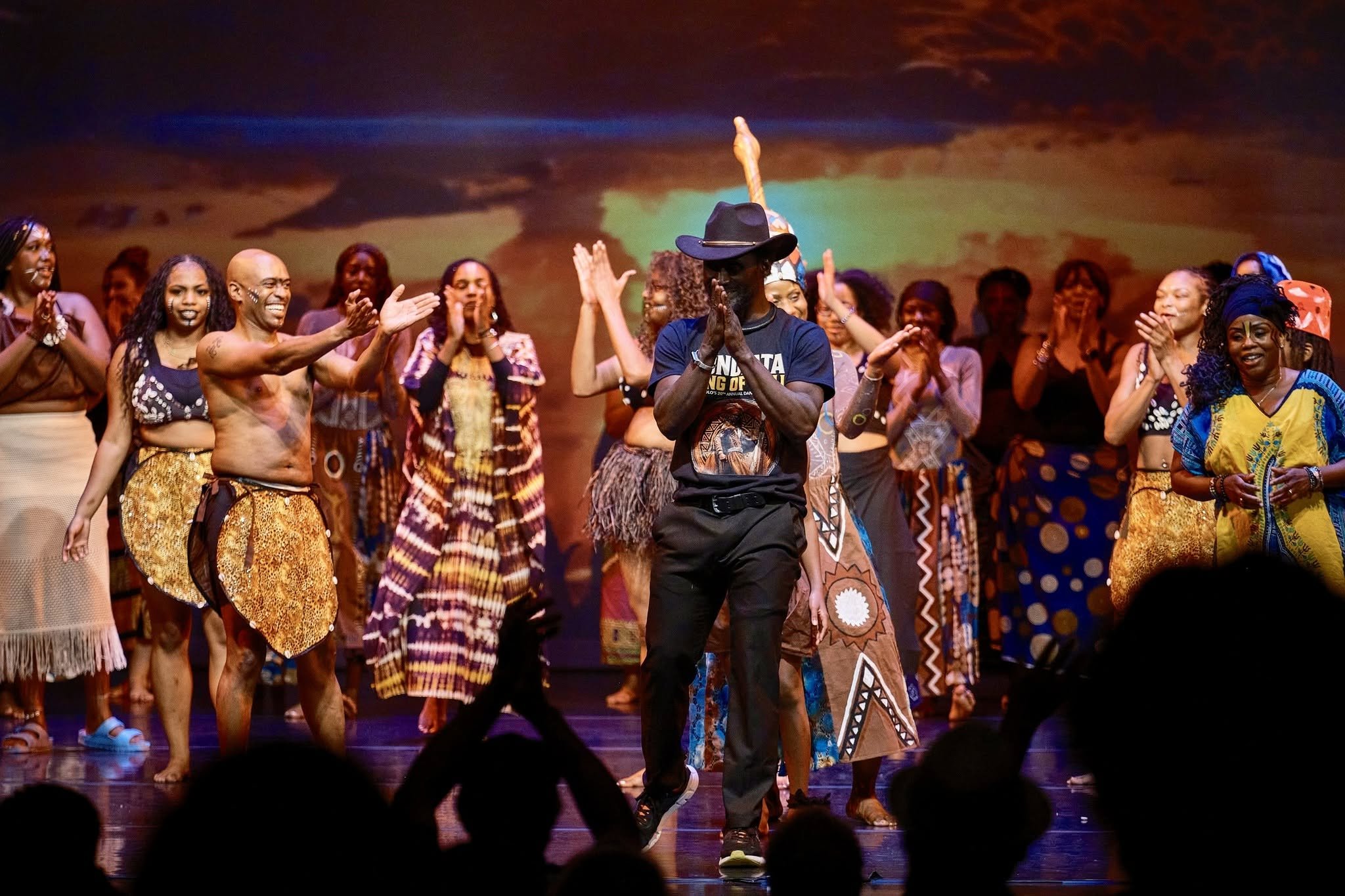
Before Disney’s “The Lion King,” the epic story of prince and founder of the Mali Empire Sundiata Keita was carried throughout West African oral history. Preserved by Griots, West Africa’s historians, the epic has endured for over 700 years, telling a story of perseverance as Sundiata fought for his prophesied seat on the throne.
Transforming the Touhill stage into desert, savannah and village, Afriky Lolo brought the story of Sundiata to St. Louis audiences with “Sundiata: King of Mali,” the company’s 20th anniversary concert, July 17-18, 2026.
Afriky Lolo occupies an indelible role in the St. Louis area. Formed by Artistic Director Diádié Bathily in 2003, the company honors cultural traditions of West Africa using dance, music, authentic costuming and oral history — this production a microcosm of Afriky Lolo’s impact and value to the region.
It is difficult to overstate the organizational and creative efforts involved in bringing “Sundiata” to the stage. With more than two hours of scripted plotlines, the company’s skilled musicians played every transition on and off the stage for the mammoth cast of more than 50 performers. A transportative functional backdrop drove every shift of scene, delineating night from day, clear skies to blowing sandstorms, and evolving village landscapes as Sundiata made his hero's journey. Costuming elevated the show’s authenticity, with some pieces rivaling most high-budget productions. To obtain authentic West African fabrics and decoratives for his company, Bathily travels frequently to the Cote d’Ivoire and Mali, and even sews many of the costumes himself. This effort is evident; attention to authenticity and quality could be found at every level of this concert.
Polished use of live drums thread together the fabric of this show, charging each entrance and exit with an electric pulse. Alongside 10 of Afriky Lolo’s musicians were seven UMSL musicians playing horned instruments, this collaboration a rich yet tasteful addition to the program. Powered by the sound, performers absorbed Bathily’s movement and transmuted it into their own expression. The choreography itself felt fresh, utilizing interesting formations and stage lighting that made the traditional forms feel contemporary. Momentarily collecting into shape only to release again into organized frenzy, the performers’ freedom performed its own testimonial to their training.
A lineage of knowledge could be found in the simplest of places; the placement of the hands moving beyond function, palms visibly informed by shared experience, the buoyant feet striking down with such elegant control you could imagine the floor unaffected. The hands were the offering as the feet held the earthly connection. Performers ranged from ages 6-60, but all appeared similarly touched by a unique gold flowing through this company.
This production moved far beyond the territories of a dance concert. With compelling performances, Zion Thomas, Ebony Easter, Trials Davis, Venezia Manuel and Keith Tyrone Williams held down the principal roles convincingly. To witness this much skill on one stage is tribute to the range of this company and the talent in its orbit.
Bathily’s cameo under the stagelights was impossible to miss. The cheering crowd nearly rose to its feet as he spun across the stage, generating such rotational power that the fabric he wore took on air until he resembled a spinning disk. It was a touching celebration of the artist who has had a notably busy year. In March he performed Zaouli at the 2026 Academy Awards ceremony during the live performance of Sinners’ “I Lied to You,” sharing the dance from his native Ivory Coast to viewers across the globe. Diádié Bathily provides a rare gift to this city, his impact reaching far beyond himself, demonstrating a commitment to honoring his heritage by educating with what appears to be ceaseless energy.
In the story of Sundiata, King Cissé addresses the importance of preserving our stories moments before his death. He says, “Stories need to be shared, or else they will die. If they die, we lose our sense of purpose.” This call to action captures the cultural significance of this company that felt evident throughout the evening. Through movement, music and communal memory, Afriky Lolo carries African, African American and St. Louis history into the present.