
HQ Review: Space Station Dance presents its 2026 Residency
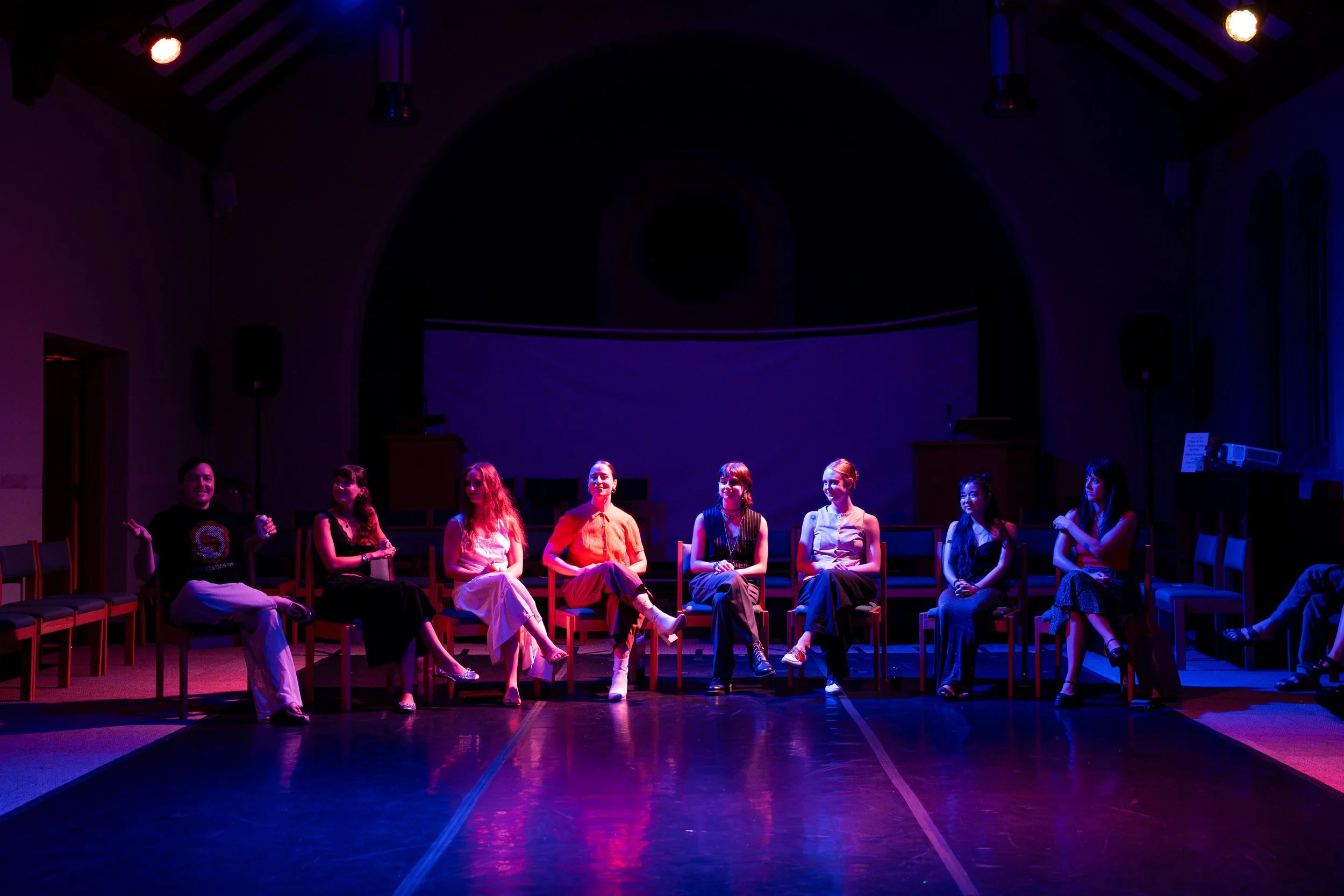
We sit in the round on pews and chairs lined against the edges of Hope UCC’s Chapel of the Arts, illuminated by lights hung from curving beams that mix blues, pinks, yellows, and greens on the black marley. Over the speakers, pop and house beats play muffling the voices of the sold out show’s crowd. The crowd is delightfully warm– show goers chat together or see someone across the chapel and hurry over to give a hug and say hello. On the three, long panels of marley in the center of the chapel, eight rocks of varying shapes and cream colors lay in anticipation for the show to begin. In the corner of the room, Space Station Dance Residency’s red and white logo is splashed over a chapel door by a projector.
Signalling the beginning of the show, the lights fade and eyes are drawn to the changing projection: a prerecorded video from Space Station’s Artistic Director Jacob Henss. It is rare for a show’s opening housekeeping speech to be met with immediate attentiveness– many often are too excited for the show to pay attention or are tuning out the same safety exit mantra they’ve heard before–, but Henss holds the audience’s attention. Flashing pictures and logos on the wall, Henss’s voiceover thanks sponsors and choreographers and while highlighting Paige Van Nest’s work with the residency and announcing the new position Van Nest will hold to continue her support of Space Station’s work. Throughout his speech, Henss instructs the entranced audience to “clap on three”, begins to count, and on ‘three’ the audience dutifully claps. As Henss thanks Space Station’s board for their hard work, the screen flashes with text where Henss cheekily reminds them to send him their headshots. Chuckles ring out and it occurs to me how deeply intimate this setting is. The watchers in this room are a part of a rich community fostered by Space Station and this evening feels part exhibition-part gathering of old friends. This space is created for those who love dance at its most exploratory, are curious about how dance is built, and the honesty and intimacy attached to experimental work. Henss describes Space Station’s work as a "recontextualizing [of] experimental dance not into aesthetic”, which is a mind opening preview for the vast array of work presented. We finish with one big clap on three, the video and lights fade, and the dancers of Helena Franzén’s Habitat enter the space to find their places.
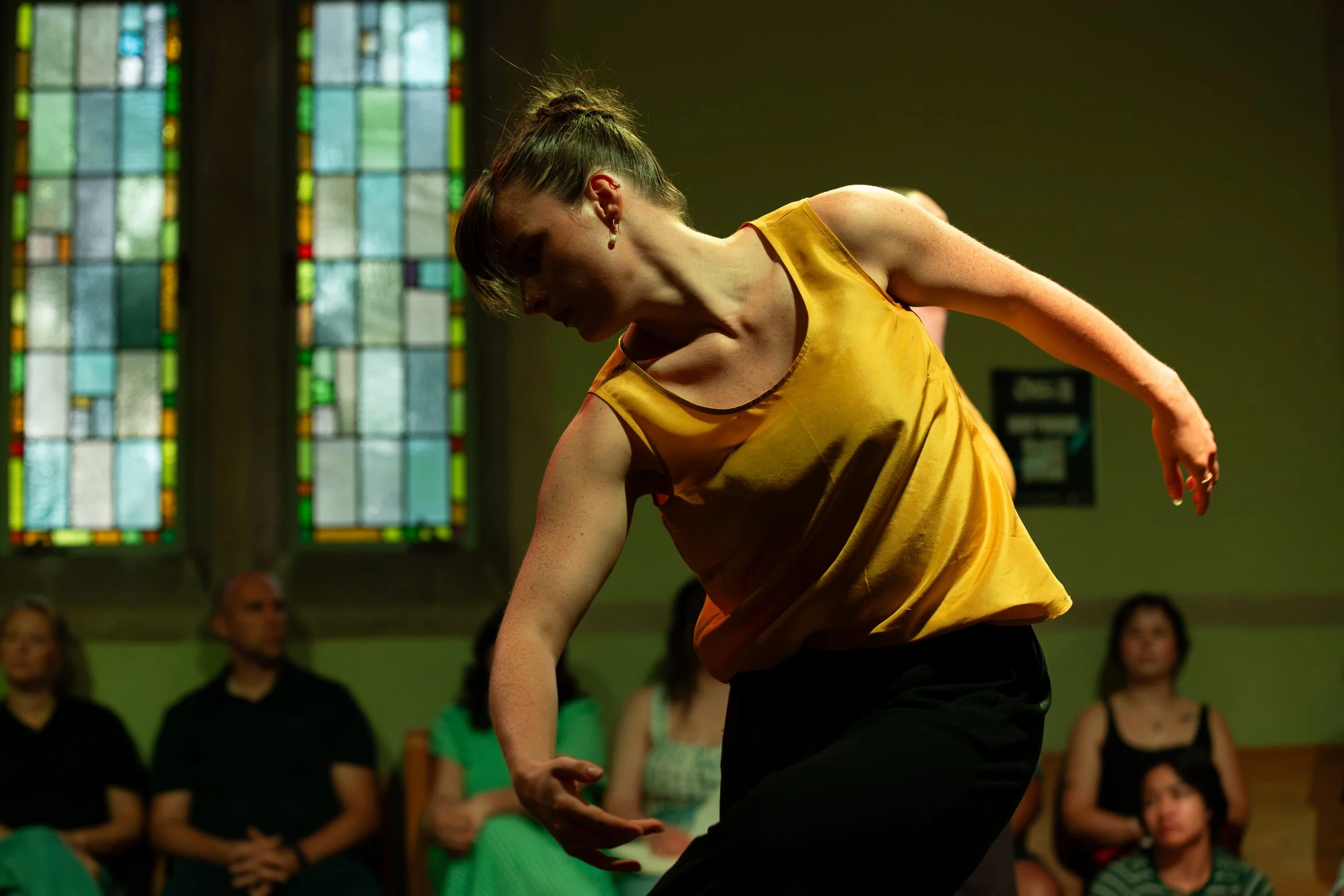
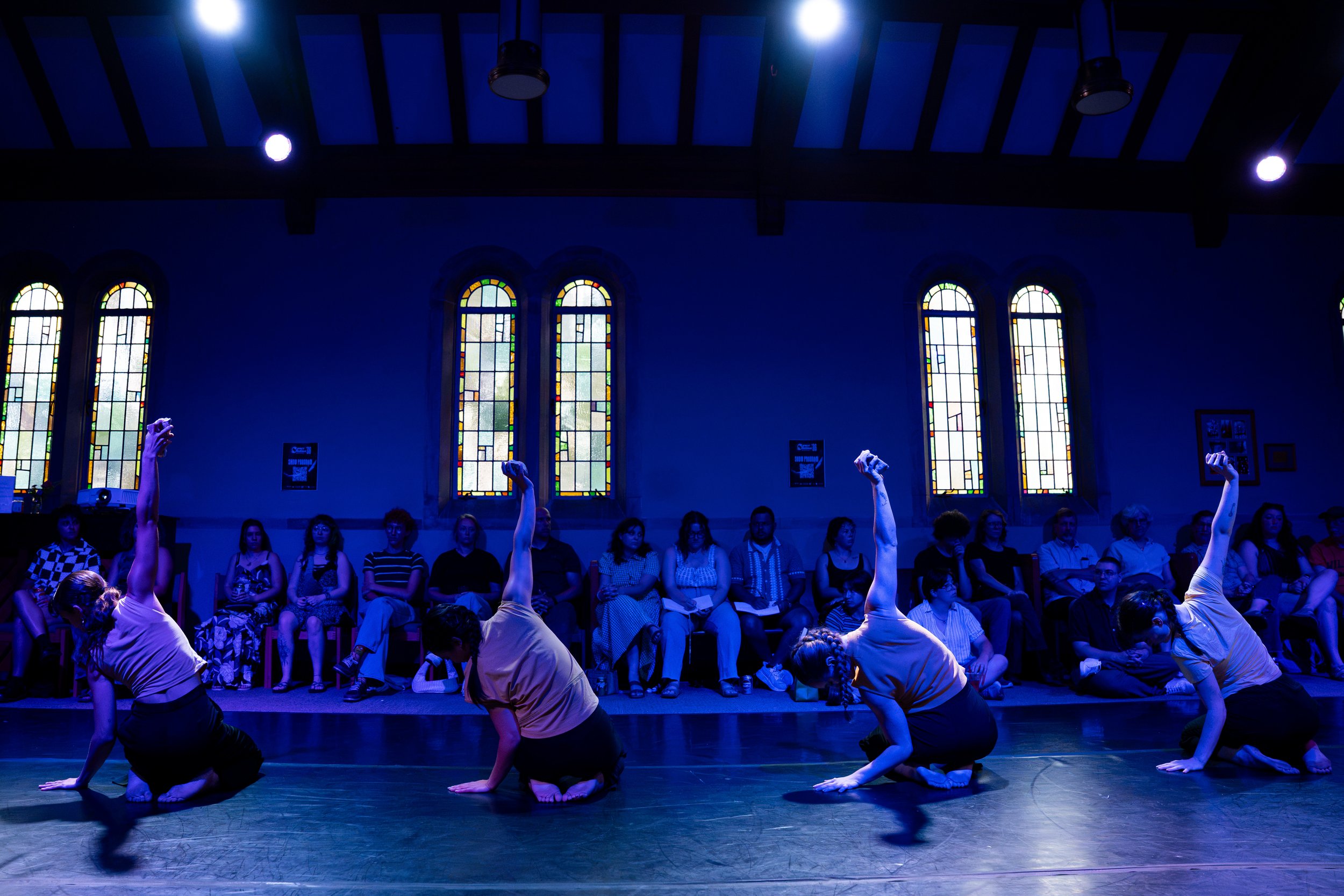
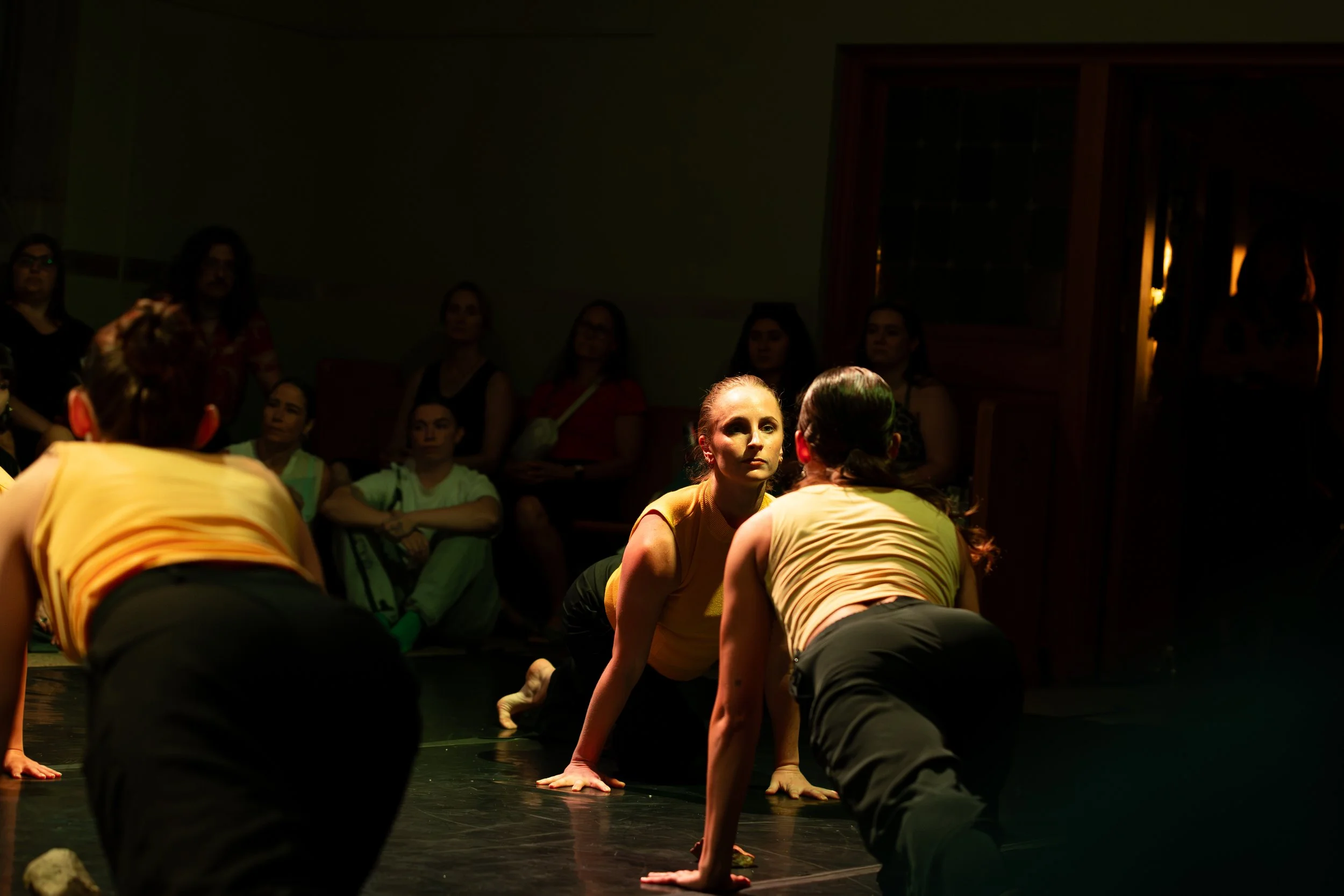
Dancers in yellow and black walk in a line, sit with their back to their rock, and slowly lie down. As the music by Jukka Rintamäki begins, the dancers perform a set of movements in various groups of unison and canon, as well as mixing the movement into various individual patterns. They sit up, shift side to side on their hands, hug themselves, kick their legs, lie down, reach forward, and whip their heads to look behind them as if someone has called their name. Dancer by dancer they turn and crawl towards their rock; they pick it up, shift it hand from hand, or put it to their ear and shake it. These rocks felt like a talisman for each dancer, an extension of Franzén’s investigation of home and how we are anchored by “Home…as a place of belonging, resistance, and transformation…[and] the environments that shape us.”
While the dancers investigate their rocks, a duet pulls away and mirrors their movement and placements of rock in space before intertwining with each other and tapping their rocks together with a resounding clink. This activates several walking patterns where dancers shift rocks from hand to hand, turn slowly as if to throw the rock, raise it to their ears, or gather in a small circle to join their rocks together in the center. This work’s quick precision, slow spinal curvature work, and various repetitions create a vocabulary off of which the dancers work and manipulate to build a complexity.
Coming to the work’s final movement, the dancers complete different figure eight walking patterns around the stage all together and then splitting apart into groups of four and finally into duets. They move through these groups until a rock falls to the floor. Then they place their rocks in a diagonal across the stage and the music shifts into a plucky, curious rhythm. Dancers stand on both sides of the lines and quickly enveloppé arms and legs, wring their bodies, and slide on the floor matching the tempo of the music. They roll on the floor and come to a stop as the lights come down and the audience applauds.
I appreciate Habitat’s ability to create a language and vocabulary that builds meaning upon meaning. Each movement is an embodiment of Franzén’s curiosity with the assorted aspects and associations of home, yet the meaning created in the work doesn’t feel like a permanent definition. One moment the shift of the rock reads as a negotiation of belonging, while other moments feel like the self control of resistance. There is a fluidity where each part of this language shares meaning, but is its own separate concept. How fitting Franzén attaches an all encompassing and individual meaning to the concept within home– the idea and place that molds, breaks, and heals us.
In the darkness of the chapel, three dancers– Alivia Fletcher, Lexie Hoehn, and Baylee McAllister– stand at the edge of the marley preparing for Melissa Miller’s And Then We Saw the Daughter of the Minotaur which was inspired by the life of Leanora Carrington and her Carrington’s painting by the same title. Holding two spools of red string, Fletcher begins to drop the string to create a large, backwards question mark before dropping the other spool at the opposite end of the marley. Following this string, McAllister crawls and scooches across the floor, pausing to straighten the string out before shushing to herself and beginning her crawls again. Hoehn trails behind her on the same path while Fletcher follows the length of the stage to connect the string’s ends. In the center, Fletcher gestures towards the audience, begins a sort of stuttered movement initiated by her heels, and then folds into a back extension. Joining each other in a circle the dancers lay on their backs and begin to mutter and then recite snippets of a line of prose. They toss side to side, their words as catalysts for movement as they repeat: “the ocean sounds different from the other side”. Eventually, they settle and Fletcher simply repeats: “My ocean, the ocean, my ocean” before fading into silence. The silence is loud; the audience is frozen to catch every word that has been spoken until we collectively jump as the dancers begin gasping for air. Indeed, the ocean sounds different from the other side. At this point, I began to feel the ache of this piece and the longing. There was a familiar ache I felt relayed to me which felt vaguely comforting.
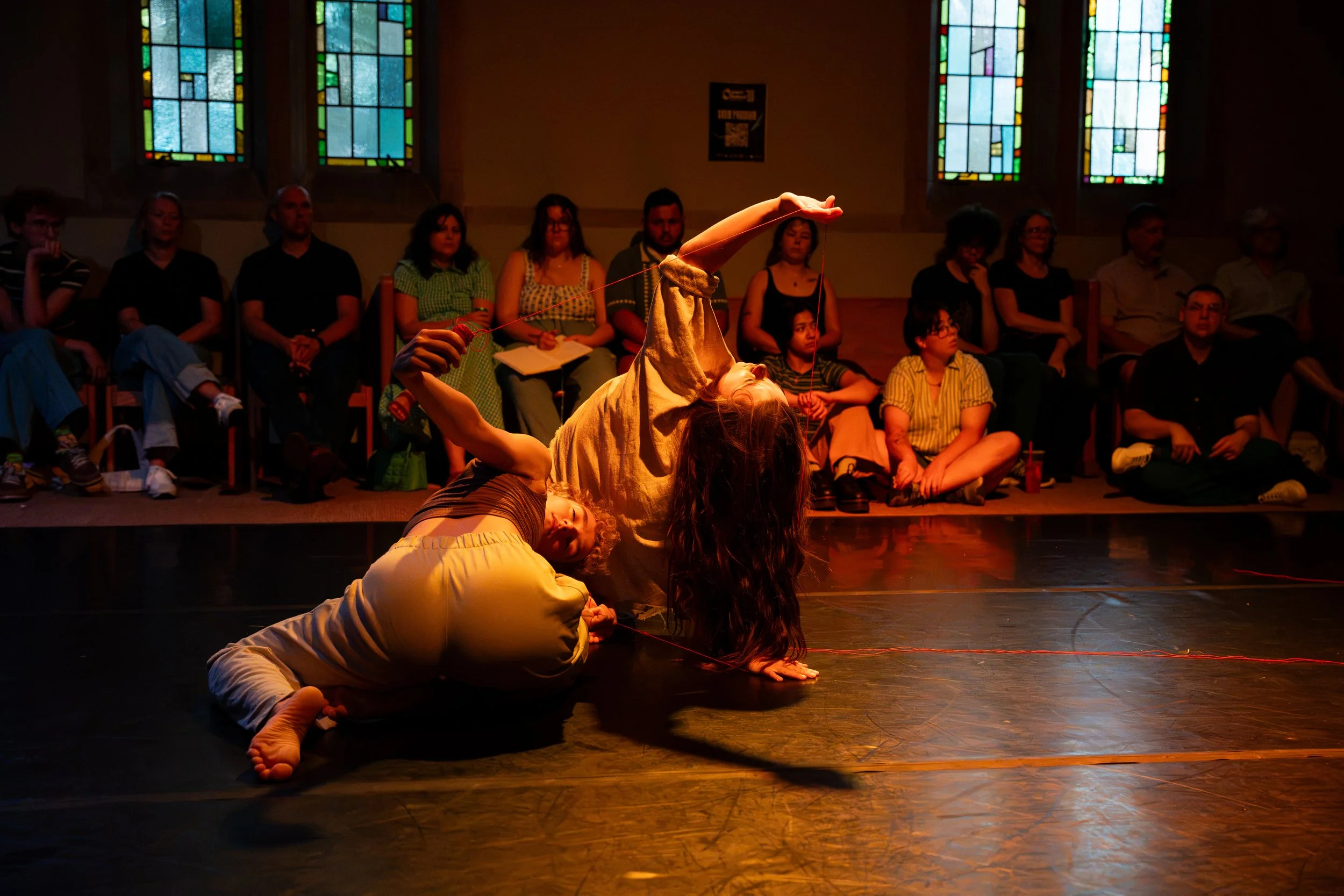
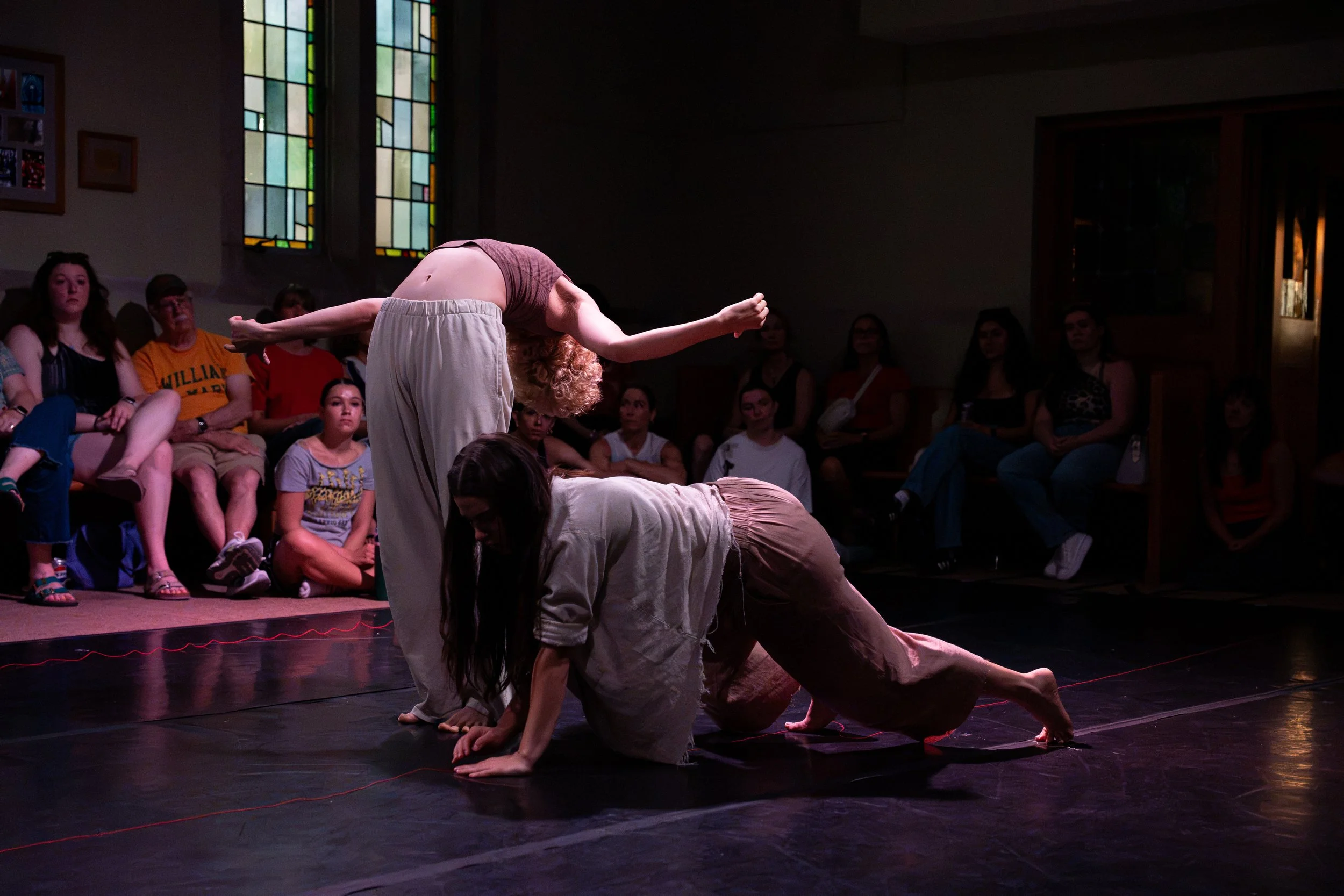
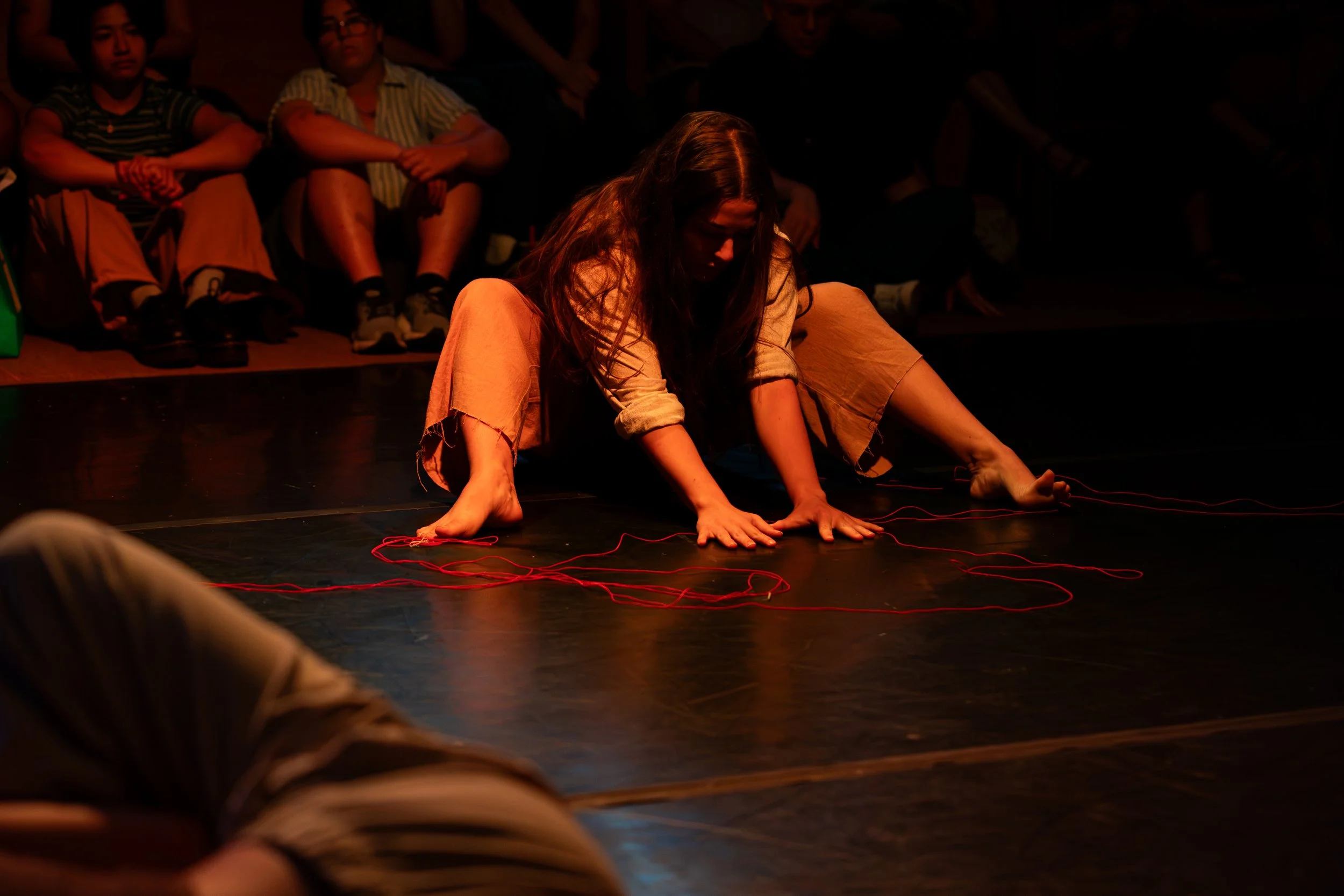
Finally, the tension and gasping ebbs while chimes and ocean waves begin to play in the background. Fletcher and McAllister begin to crawl around the floor to collect the unspooled string, as Hoehn stays in the middle to perform a solo. In the last movement of this piece the string unfurled and Fletcher and McAllister create a loop while Hoehn pulls the string across her neck, hands, and feet. They begin to create a series of tableaus where they twist in and out of the string, create shapes, and– what I find most interesting– manipulate Hoehn’s movements. Within this series, Hoehn is entranced by this string: she moves through, under, and over until settling herself on the ground as Fletcher and McAllister lift the string above her. I found this piece particularly rich and reflective due to its symbolic nature and inspirational foundation. There is so much to chew on in this piece that I kept yearning for the piece to slow down in order to consider every aspect of the work. There was an ache I wanted to sit in and by that begets curiosity and leads the audience to consider and connect the relationships between movements, concepts, tangible symbols, and other pieces of art work.
Closing out the first half of the show was Kyla Kikkawa’s “Spiritual”. Based on the idea of building heaven on earth, I noticed this work felt like the process that comes alongside building a haven that exists in the past, present, and future. As the piece begins “PlayStation Startup/Console Music” begins to play, a signal for the dancers to boot up and begin. In a circular formation, six of the seven dancers hold a candlestick while the seventh dancer holds a lengthy handstand. They curl out of their various holds and begin their own slow solos where they play with the space between popping and releasing into extensions. They move into a new solos where they incorporate wringing and floating movements as if they are floating on the wind.
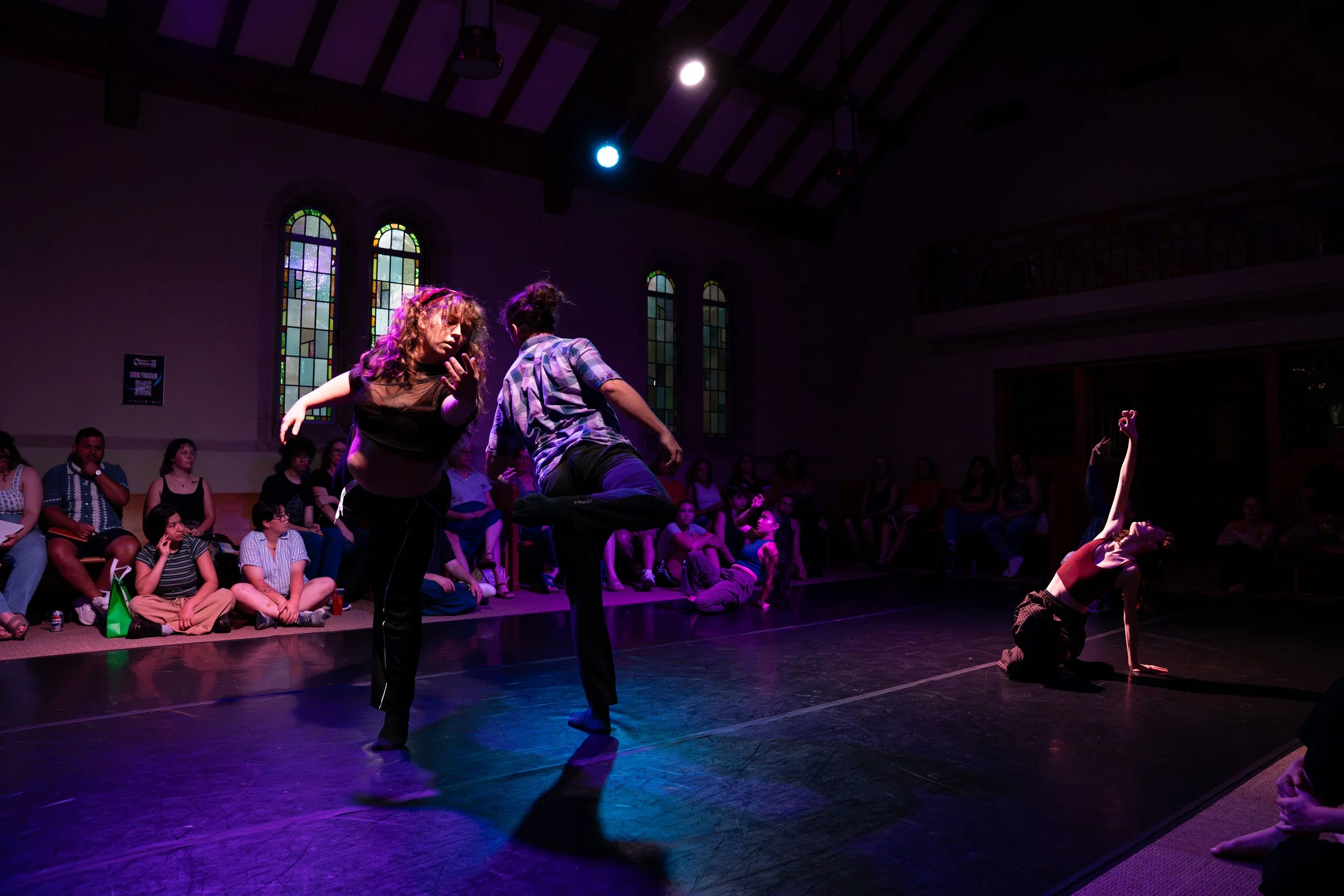
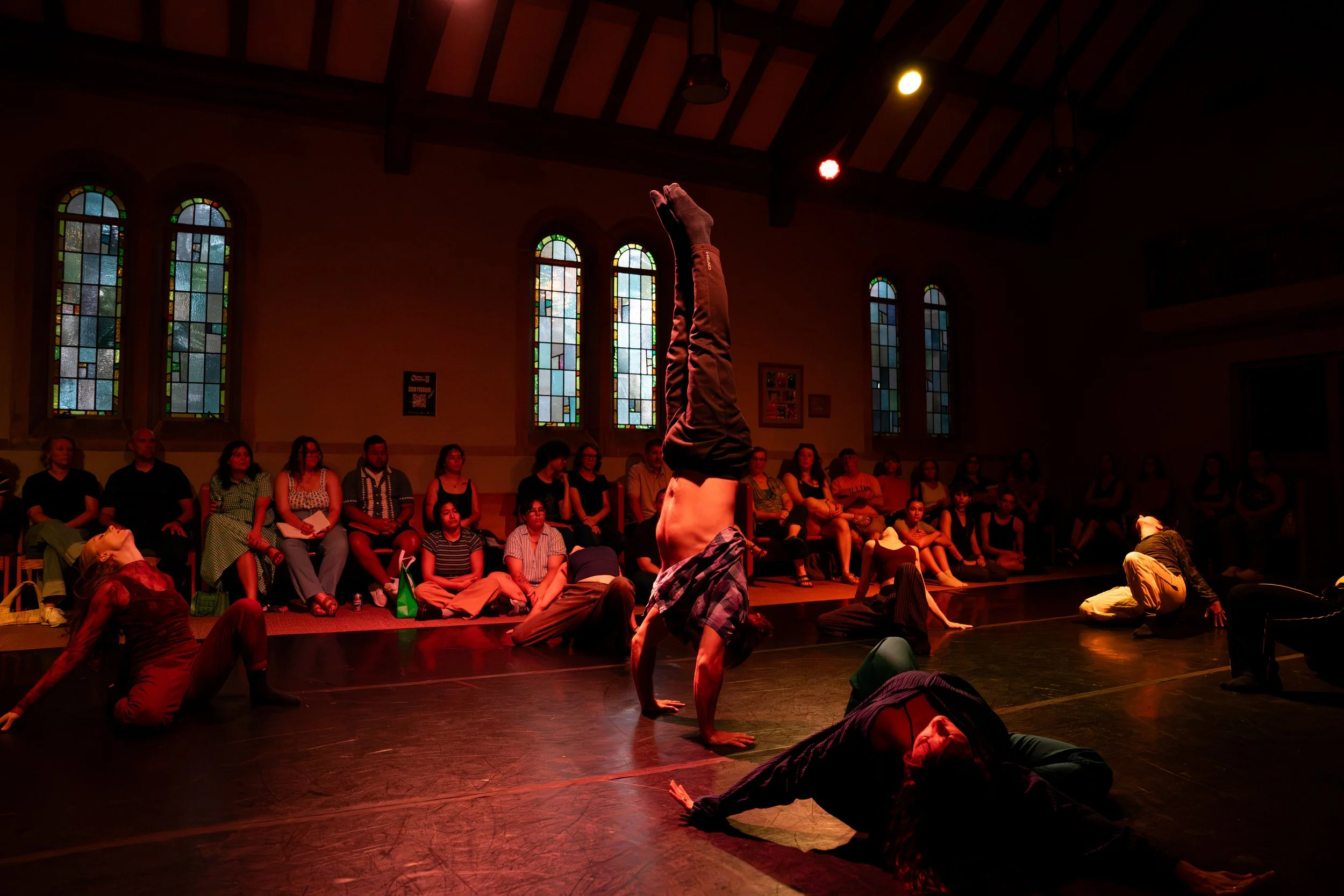
As this piece continues, I am struck by the construction of various vignettes throughout the piece. Many ideas and textures of motion are explored, powerful lines and ripples lead into quick inversions, or dancers seem to float through space and time their movements soft and contemplative. One of my favorite vignettes brings the dancers to a tight circle where they do a groundless moonwalk that seems to stretch space and time. Bringing the work to a close, the dancers circle up for a final time to perform a quick, sharp phrase. Within the circle they twirl, slide, execute floor leaps, and find walking patterns before suddenly running off stage and out the chapel’s door. It is as if they were sucked out of the space to explore and build elsewhere. Reflecting on this piece, it felt like a timeline of processes while acknowledging the individuals who help shape a haven. The staging and focus on rotational movement and circular formations nods to the focus on eras of time, as well as signalling to collectivist concepts.
Opening the second half of the show was “Listen” created by Claire Bryant in collaboration with her dancers– Julia Dawson, Cait Lewis, and Bella Shea– on both choreography and sound score. This work can only be described as a slumber party game show gone wrong, yet absurdly right. Bryant revealed in the Q&A that she wanted to explore the embodiment of the weirdest noises her cast could make. The dancers begin this piece by bowing their heads and kneeling in a circle. As ethereal chimes echo in the background they roll their shoulders and snap their heads up on a loud ding in the score. They crawl towards each other and wriggle and bounce to stand. As the piece continues, they create various vignettes where the sounds in the background accompany a scenario that they play out: at first they are looking for something; then they knock on a door and listen; they open a window and crawl outside; they lift one of the dancers up and they looks around before shaking their head no; finally they open a door and they get sucked through (cue accompanying sucking noise).
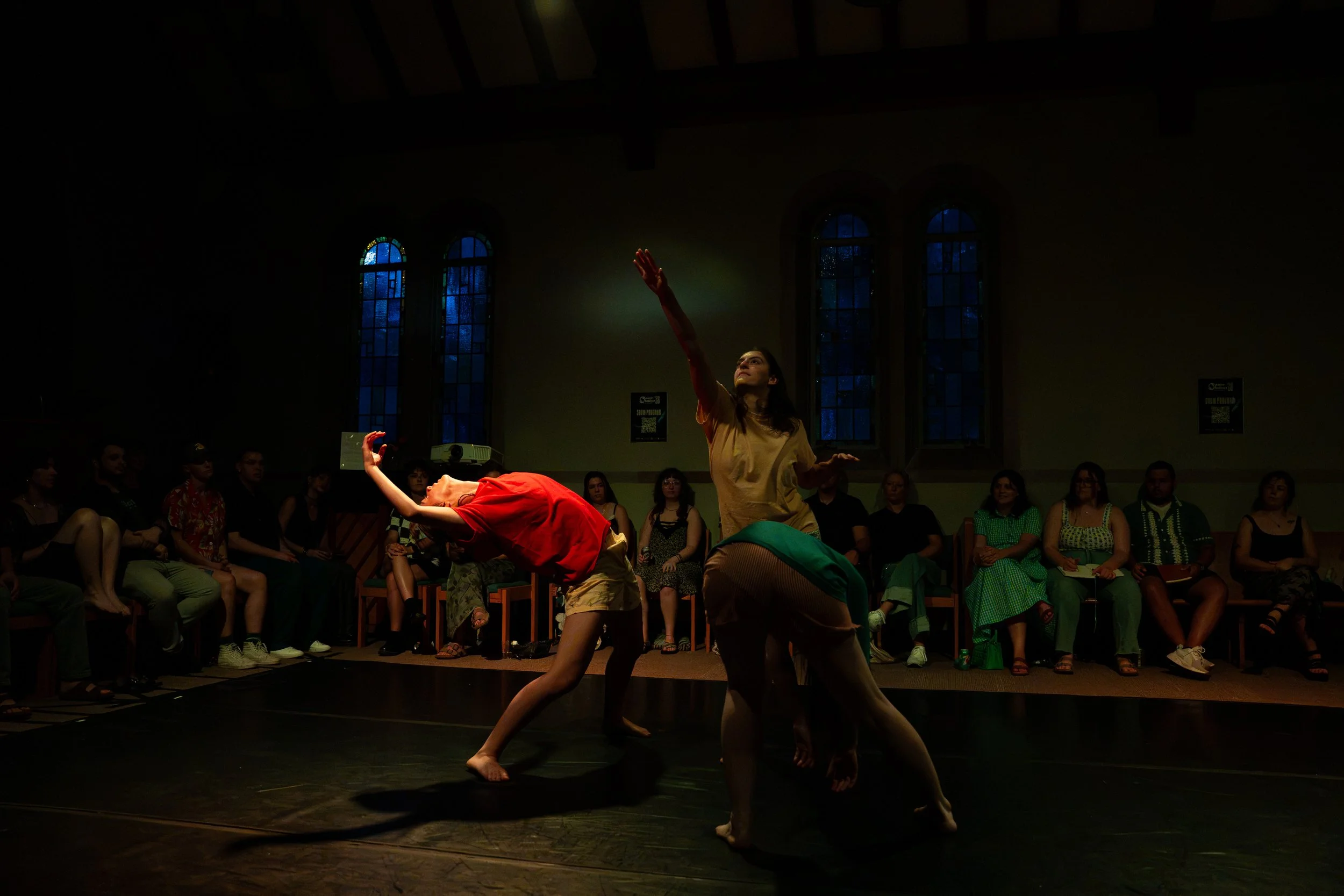
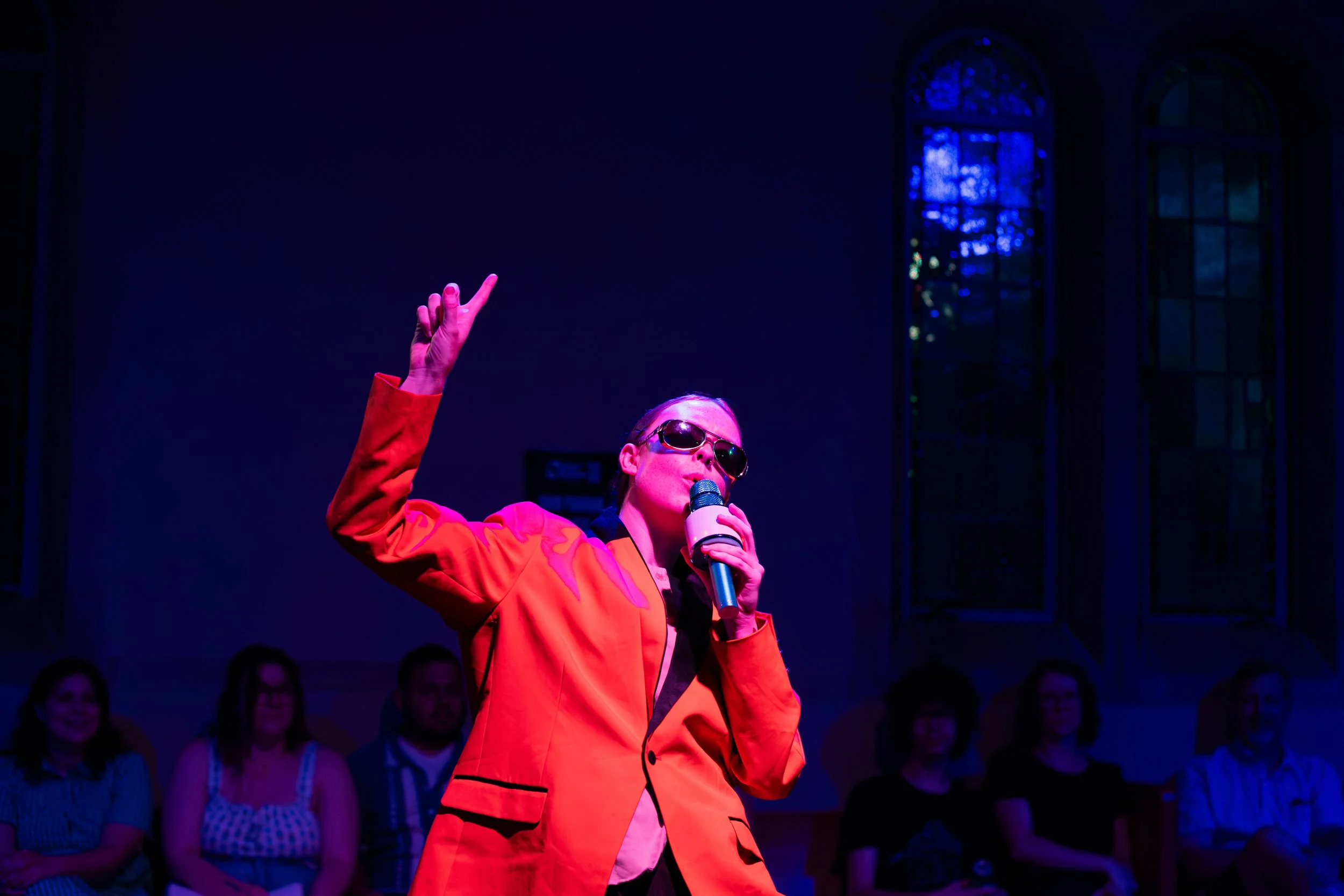
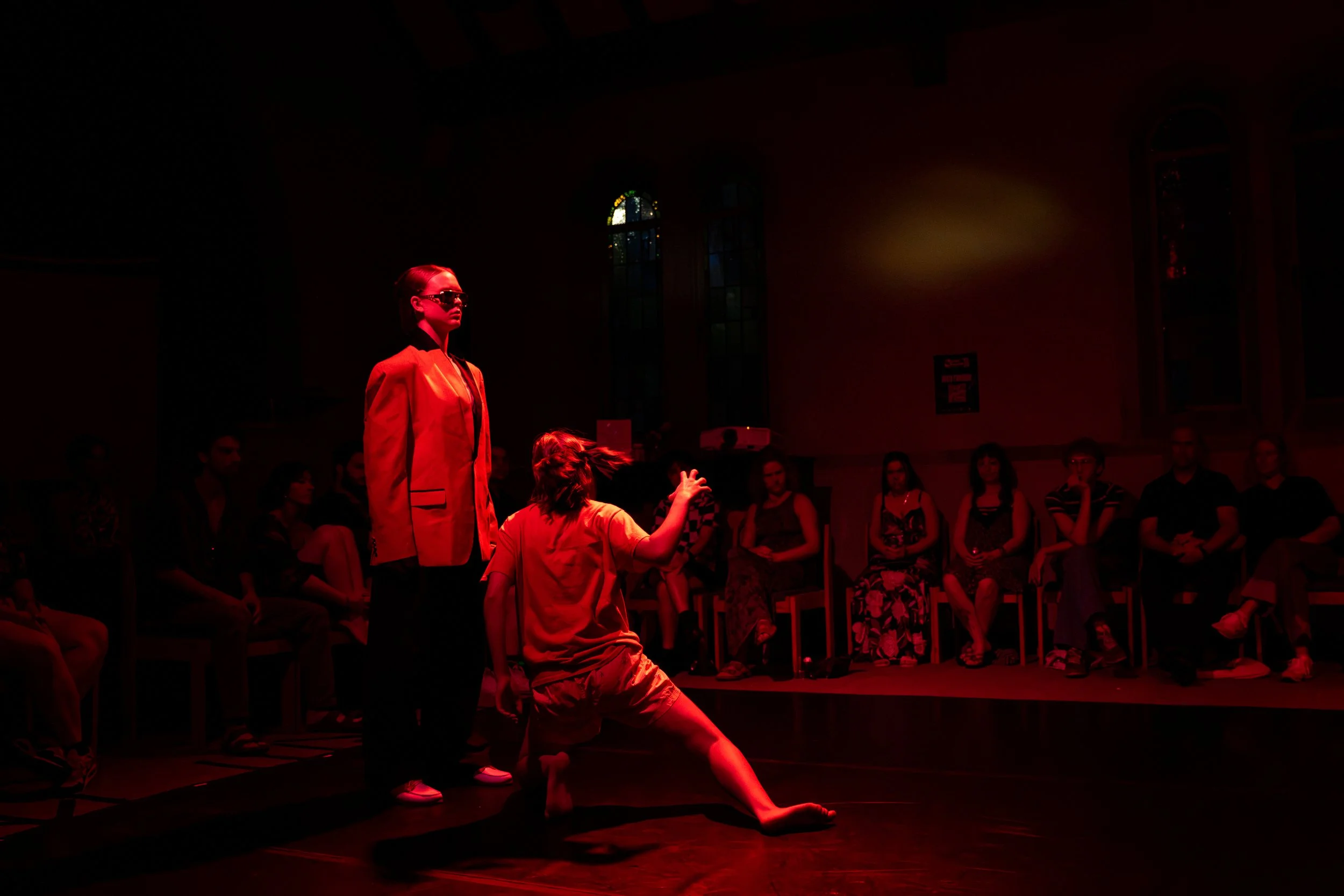
Pulling their bodies through this ‘door’, they run and fall to the floor, a bright light spotlighting them. Confused, they stand and begin to look around at the audience breaking the fourth wall. Suddenly, the room brightens, gameshow music blasts, and Bryant walks on the floor with a microphone dressed in an orange suit and black sunglasses. “Welcome to become that sound!”, she says into the microphone and proceeds to explain the gameshow as one where the audience makes a sound, the contestants embody the sound, and if it isn’t good enough in her eyes they are out. Finding an audience member to create a sound, Bryant holds the microphone to them as they create a sound which I found to be similar to a cat gagging. Each contestant begins to attempt an embodiment, but nothing satisfies Bryant. The lights shift red and Bryant stands still while a sort of fight sequence begins where the dancers work to move towards Bryant to reach her. It's almost as if a magnet repels them, but finally one of the dancers reaches Bryant, falls to their knees and looks up. Bryant looks down at her and the lights dim. As the audience claps and the lights come up, the dancers look around confused and worried by our presence. “Listen” was one of my favorite works of the evening due to the clever layering of the uncanny and the absurd. It is often tricky to strike a balance of absurdity and seriousness and Bryant molded it beautifully. The narrative of this work allowed the audience to relax and follow the story while feeling the shock and sensation of the uncanny in the right moments.
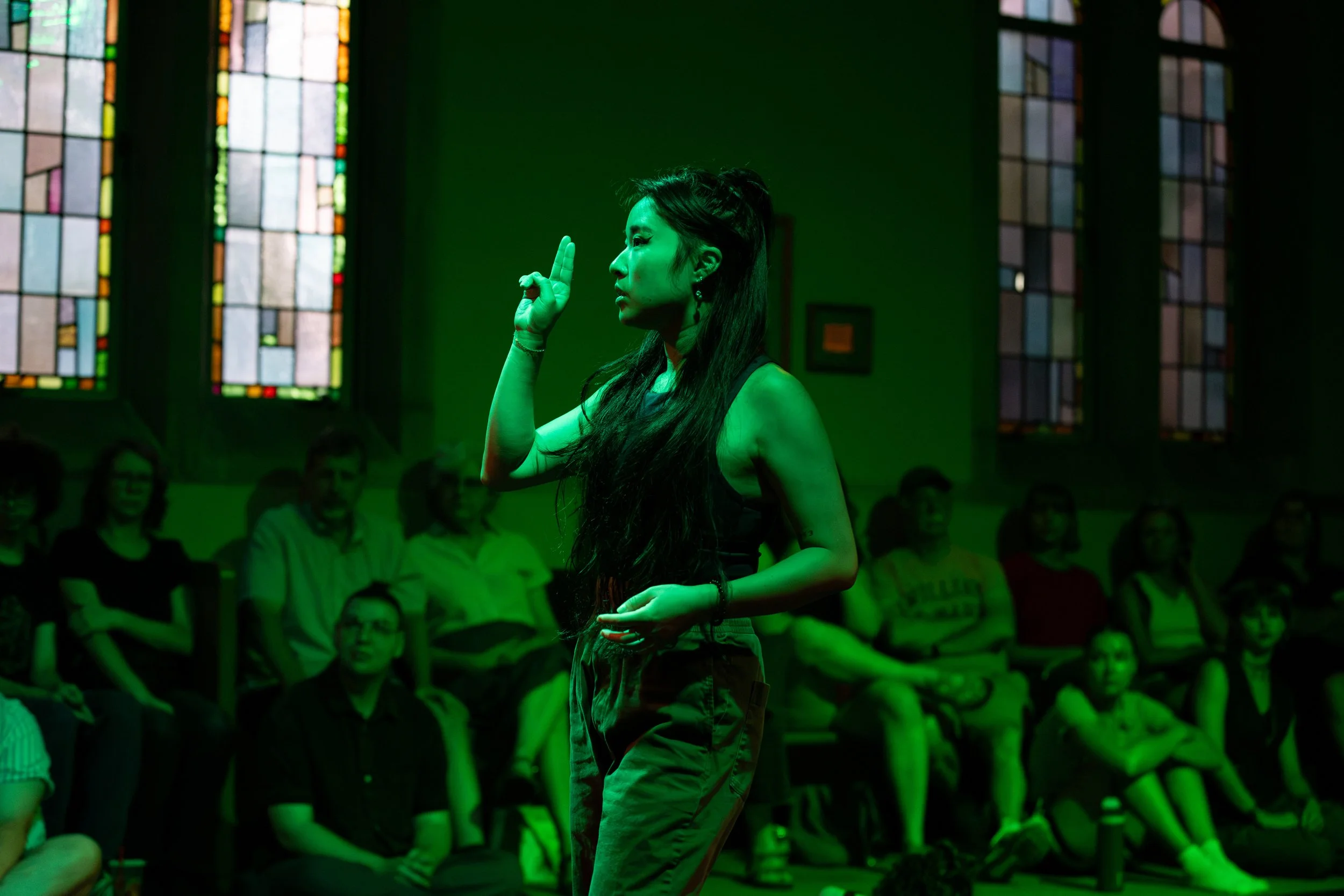
Following Listen, was Avi Pellegrinetti’s Here It Happened. In the Q&A, Pellegrinetti described the foundation of this work as an exploration of the legend of the Tower of Babel and Sumerian myth and language. The dancers begin with a series of movements where their pinkies and thumbs are extended and they cross their body, they twist and curl, pull their hands behind their head, and clasp their hands. As they move around the stage I am reminded of the piece’s program note which quotes Neal Stephenson: “Well, all information looks like noise until you break the code”. I begin to challenge myself to identify what is part of the work's vocabulary and what is maybe more ‘one-off movement’. This work doesn’t utilize music, so all focus is on the movement and any noise assists in building the language. The dancers work a lot in unison performing floor work where they thread legs and arms through, curve, and fold. When they solo by themselves they work off of their mutual language, but often a dancer will clap or snap to signal moving into new phrase work. As the piece ends, one of the dancers walks out while the other two form a duet where they cross and lunge until they, too, walk through the chapel’s doors.
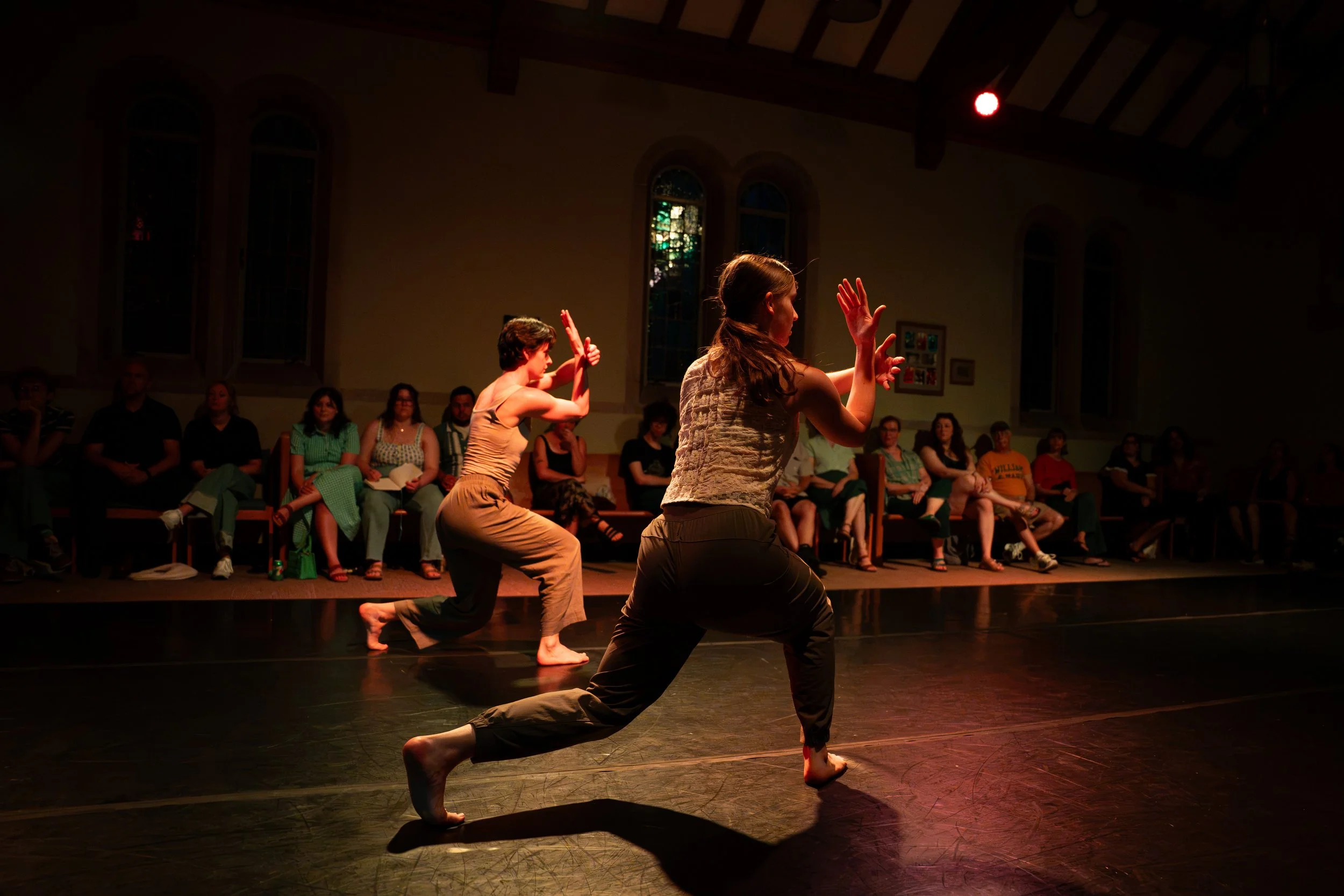
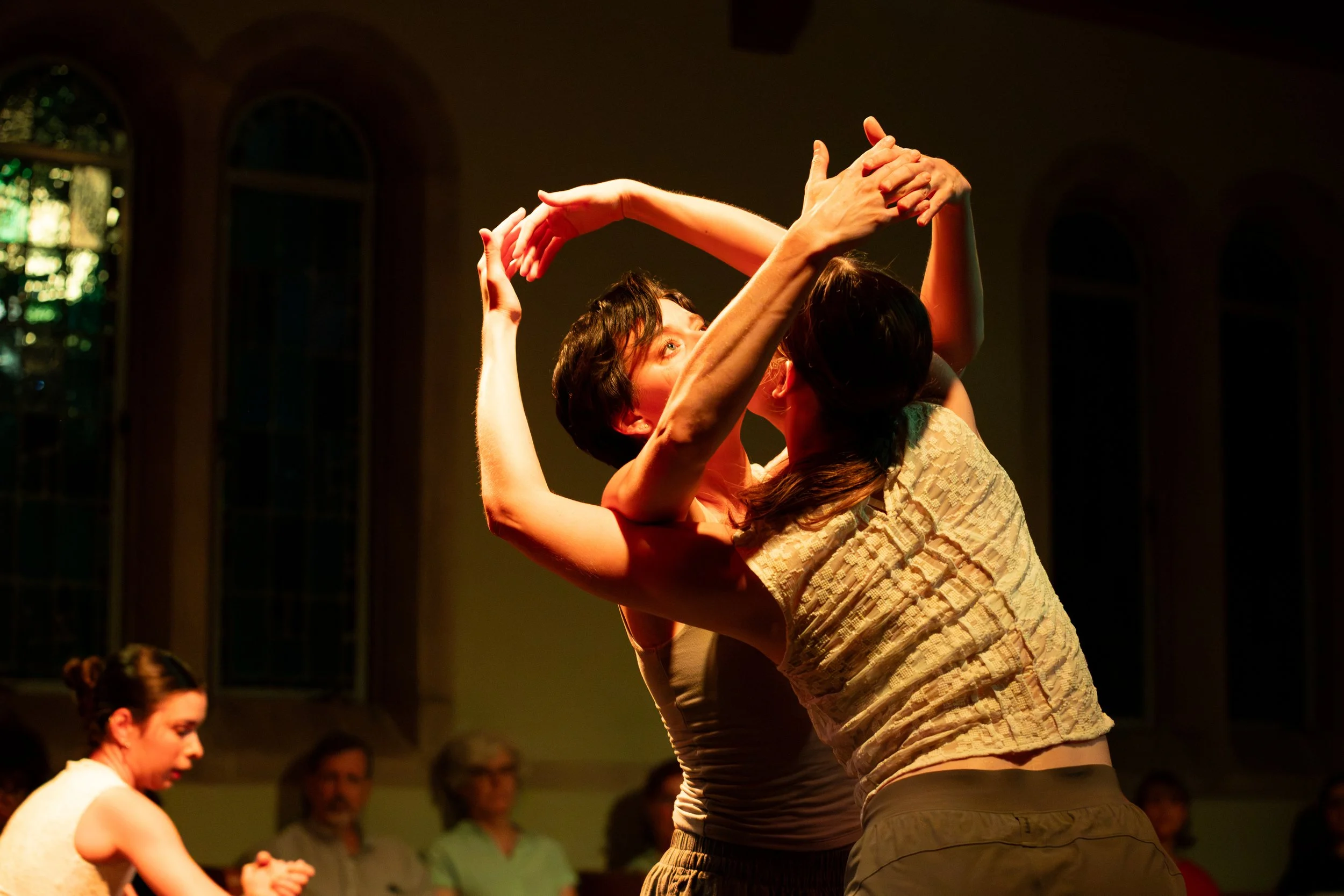
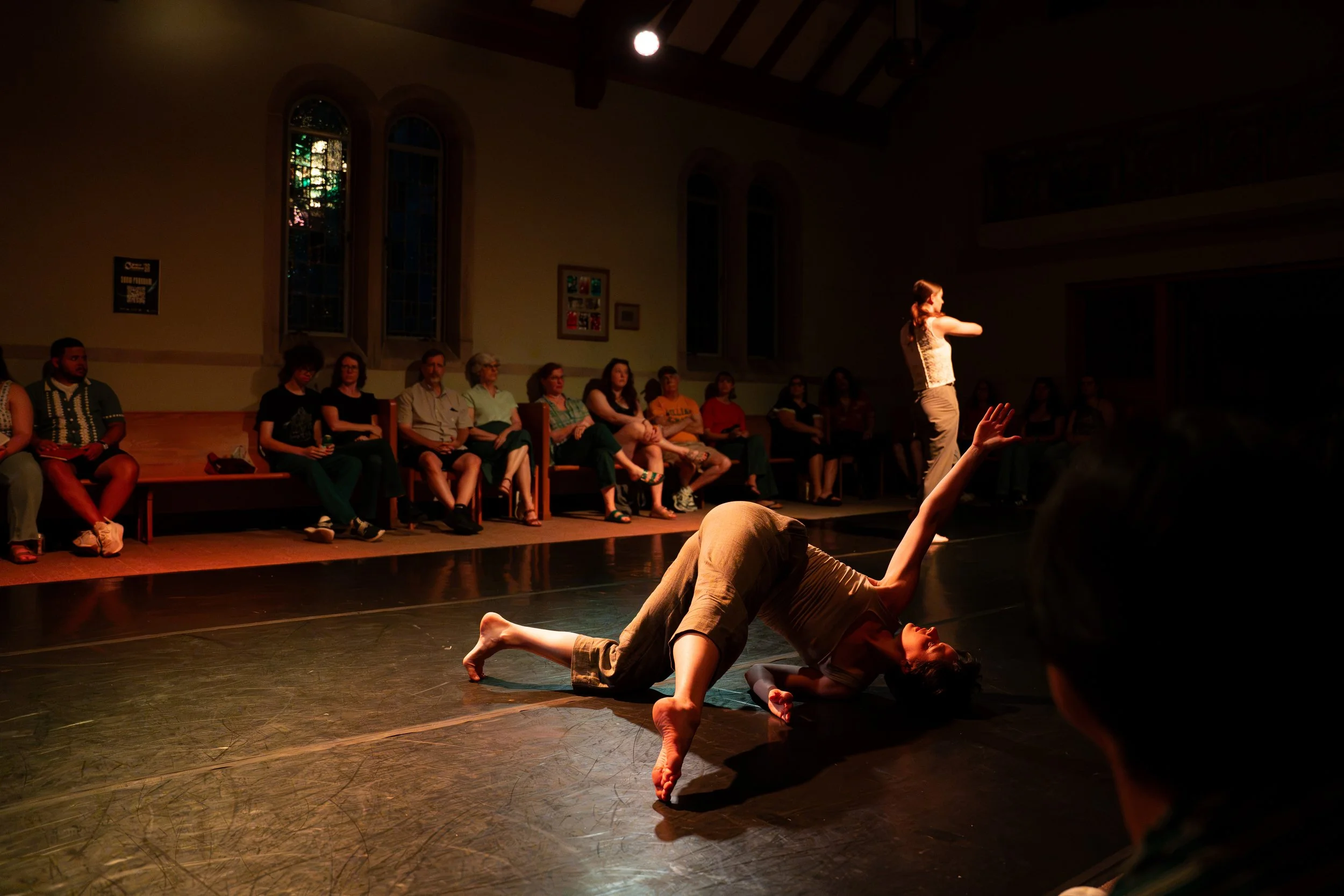
Watching this work was an exercise in translating and decoding movement into thoughts. The logic of this work was challenging in the sense that the audience had to decode movements and identify the vocabulary of the piece. Sometimes the dancers— Emilee Morton, Paige Van Nest, and Ellie Barry– changed the texture of a movement that felt to me to change the tone of the meaning.
Concluding the evening’s showing, is Jane Tellini and her cast’s creation What the Dark Soil Knows. Between Here it Happened and Dark Soil, eight thick, red ribbons are rolled along the length of the marley and taped down, before the lights come down to allow the dancers to enter. The goal of this work is to consider “How do the lives and stories of those who came before us continue to live through us?” while honoring the Japanese avant-garde dance genre Butoh. Considering the themes of this work, I am curious about the meaning of these red ribbons. Four dancers– Anna Brady, Liliana Merifield, Reuben Thomas, and Jane Tellini– enter in various dresses and draperies of whites and creams carrying large white flowers with brown stems. In the center of the room they form a circle facing the audience, place their flowers down, and fold themselves into a sunken, bent kneed tendu. As the piece begins, they stretch and straighten their bodies towards the sky before slowly folding into their beginning pose. So far, this work feels internal and personal; each dancer in their own world and consideration until they pick up their flowers and step swinging and curving their torsos until they face each other.
Utilizing the hand holding the flower, they spoke the flowers through the center of the circle to create a wheel.Slowly they begin to turn the wheel, their outside hand gently undulating and briefly shifting the dancer’s perspective outward. Completing the circle, they curl their unspoked arm to their neighbor and begin to bend and squat low before pushing up and extricating their flowers from each other and breaking off into solos. Alongside the flower theme and title, these moments feel like the establishment of roots breaking dirt apart, searching for nutrients, and stretching to the surface to grow.
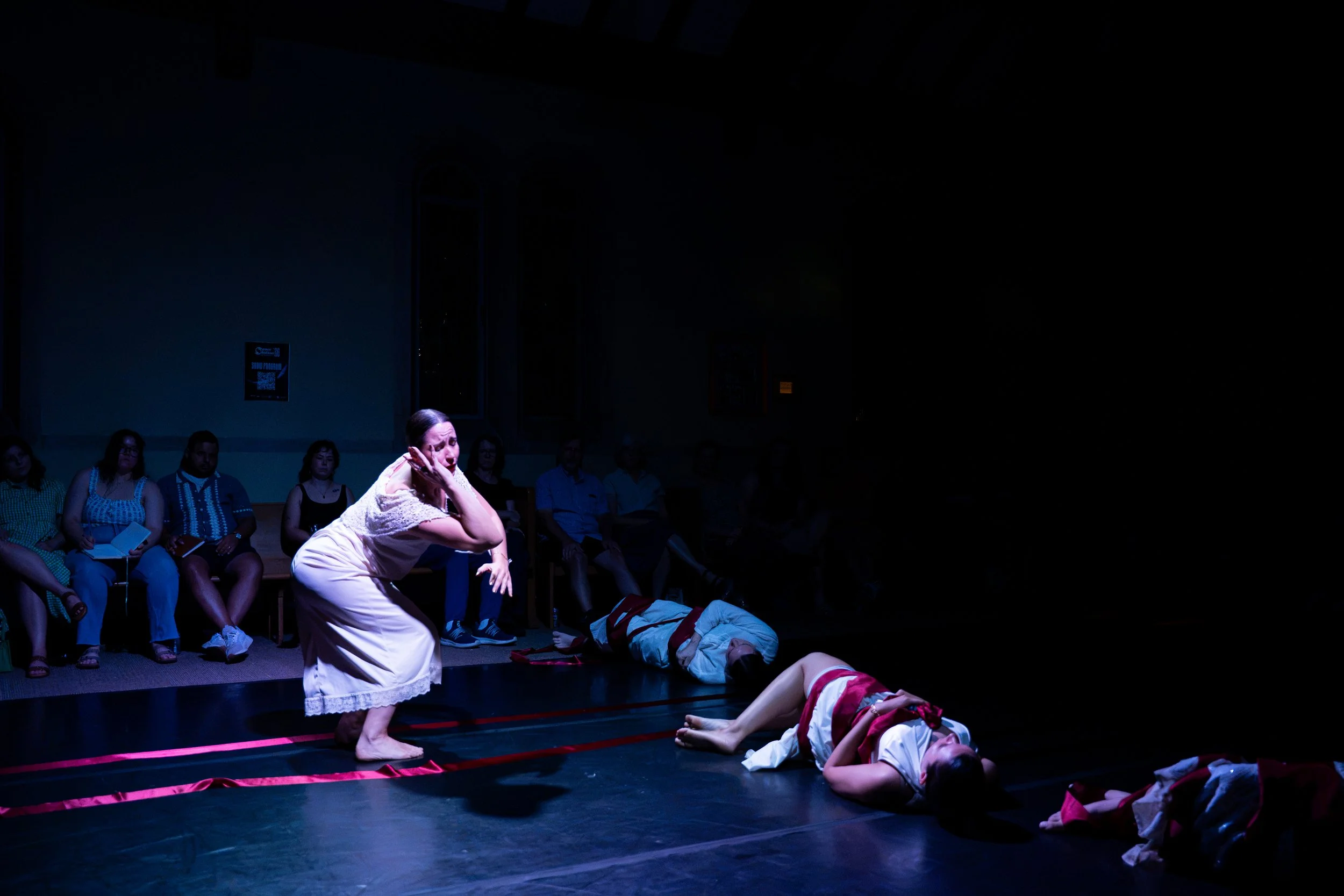
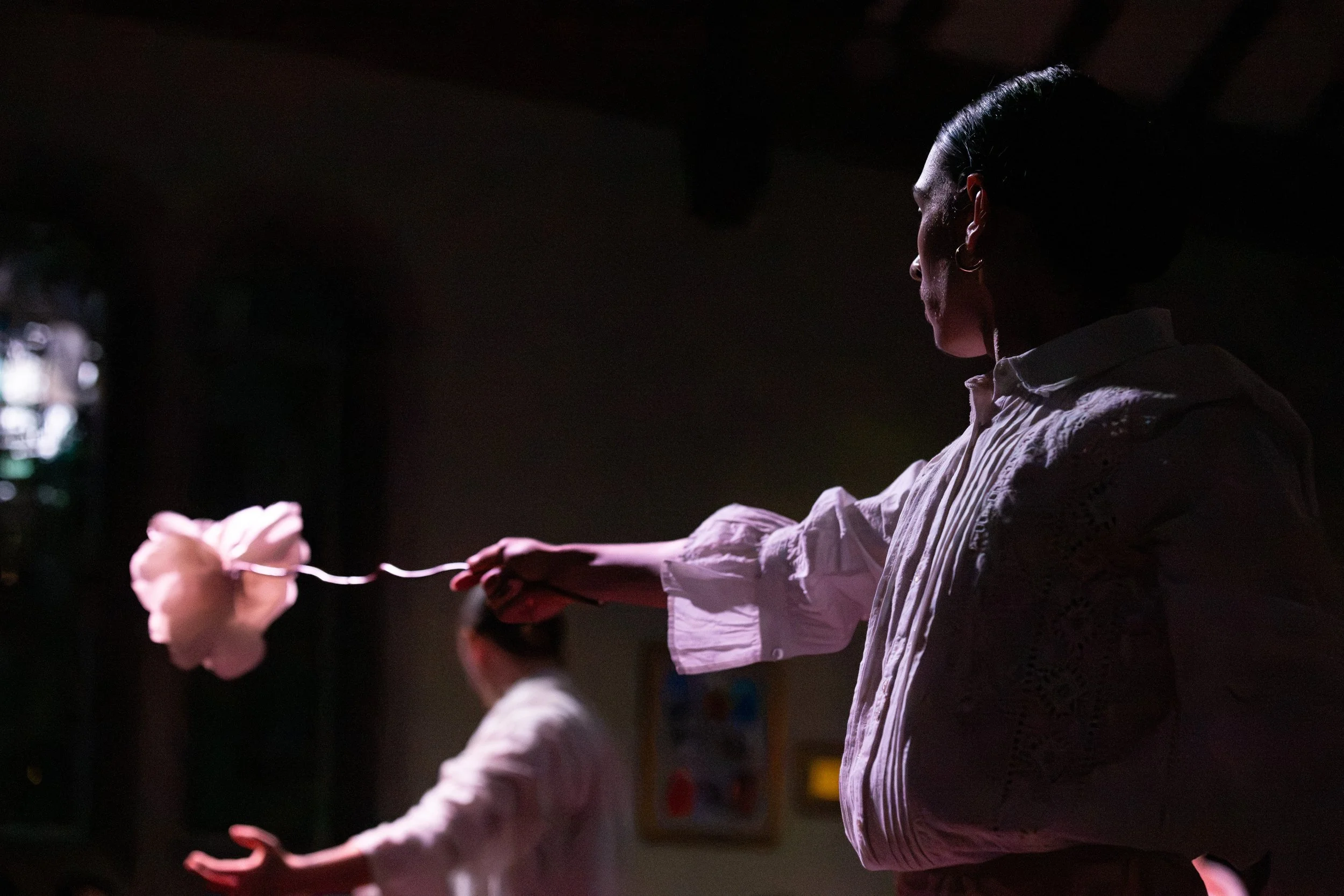
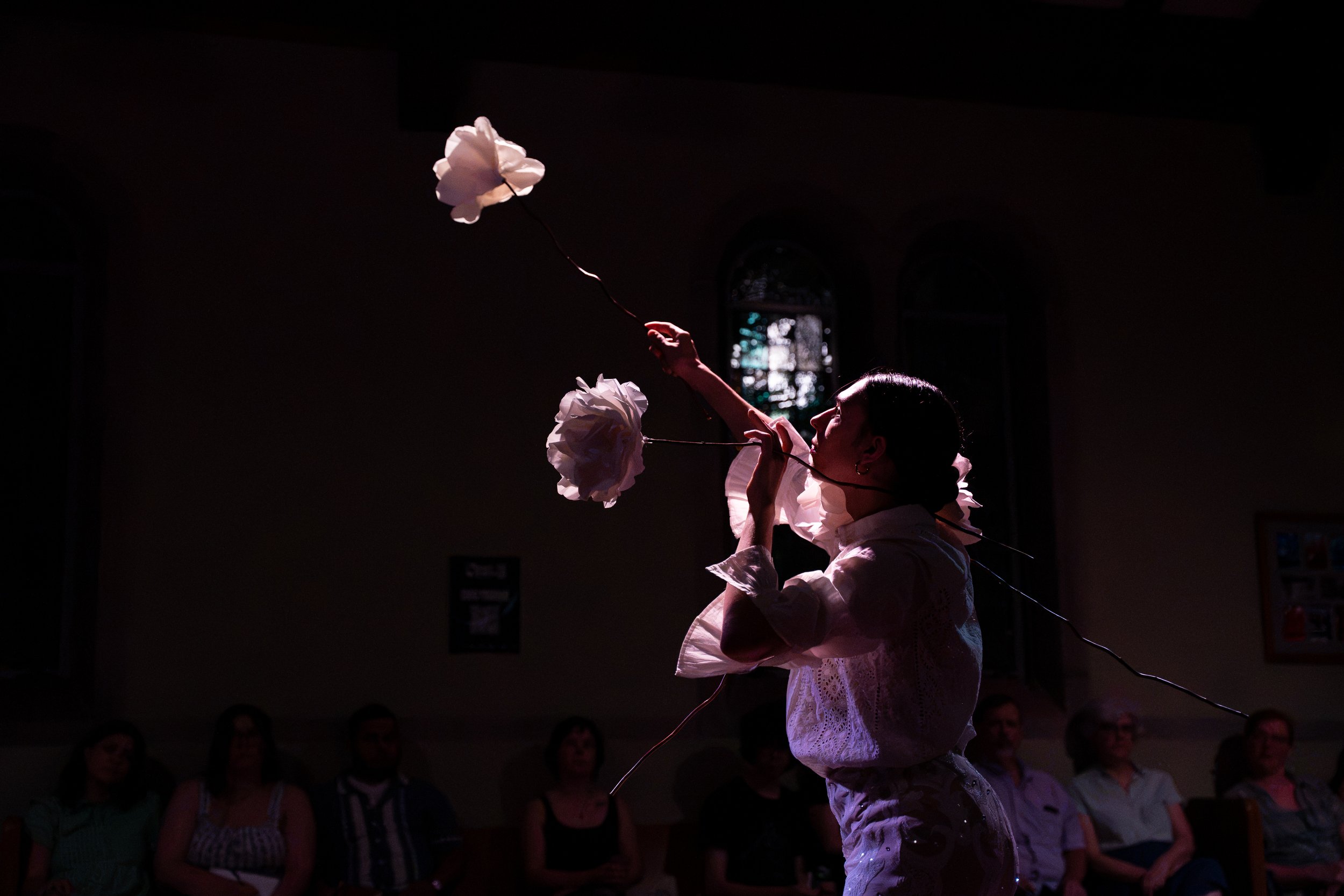
As the work continues the dancers engage in their own solos, the dancers spread away from each other holding the end of the stem to their chest as they twist and curve before bringing it to their head, their stomach, the back of their neck, and finally their feet to complete their lengthy solos. In the after show Q&A, Tellini reveals this moment as an opportunity for dancers to connect with the lineage of their families and a moment to honor the minds, the stomachs that have been hungry, and the miles their ancestors’ feet have journeyed. One particularly poignant moment after these solos, reads as a collection of a lineage. The dancers lie down together, curled and still for a time before standing and escorting one of the dancers to a set of ribbons at the edge of the marley. In the background the horns of “song for Jane- two” by church pants gets louder as the dancer is tenderly guided to lie down on the edge of the ribbons, their flower laying alongside them. As this gentle guidance repeats, the dancers on the floor begin curling themselves in the red ribbons until everyone but Tellini slowly wraps themselves in red. Having collected the flowers, Tellini bows her shoulders and eyes into the flowers as Après un rêve, Op. 7, No.1 begins to play. She places the flowers on her own set of ribbons and begins to dance away from them, following the dancers slowly rolling offstage. The lights begin to dim over the flowers as Tellini scoops and thrashes her arms. As I watch, I am reminded of what my dark soil and roots know. Inside of me is the memory of women from another century who fought for survival, eluded death, and bravely endured so I could be. Innately I feel them within. As the lights fade, I notice Tellini’s movement is initiated from her sternum; her heart led by those who have come before her.
Following the performance, Henss leads a Q&A with several of the choreographers and performers of this show. They speak of their processes, the shifts made from their research proposals, and how all along through experimenting the works find them in authenticity rather than in the strict allegiance to their general proposal. It’s delightful to listen to them each speak candidly about the process of this show. There is a distinct lack of pressure to find the ‘right’ movement or concept, and they seem to sit with the knowledge that “right” is not in the vocabulary of the experimentalism or authentic to the process . What is most exciting about Space Station is its commitment and continual reach towards building the legacy of experimentalism, rather than finding and establishing– as Henss so wisely put it– aestheticism. I am excited to return and experience alongside this rich community for many shows and years to come.
Photos by Carly Vanderheyden